2009年7月22日水曜日

Forrester Bucks Conventional Wisdom on Cloud Computing

調査会社のForrester社が企業に対するインタビューを行い、Cloud Computing(Internalおよび、External)の両方についての意識調査を行い、結果を報告した。 
 
下記の要件が明らかになった。
1) IaaSの実運用に入ろうとしている企業が全体の1/4を占めた。
2) Internal Cloudの採用に関しては、External Cloudに対する興味と比べて低い
3) 企業の興味はInternal Cloud、External Cloudのいづれかに偏っており、両方ではない
4) 大企業は中小企業と比較して、 IaaSに対する興味を持っている
5) IaaS(External Cloud)の利用方法としては、テスト/開発としての運用と同様にアプリケーションの実用環境としての利用も等しく多い。 


A couple of weeks ago Forrester released a report on cloud computing, based upon a survey of small and large enterprises located in North America and Europe. I was particularly interested in its findings as it addressed the question of private (internal) cloud computing, given my recent CIO.com blog series, "The Case Against Cloud Computing."

[ Read the whole CIO.com series, "The Case Against Cloud Computing," by Bernard Golden. See Defining Private Clouds, Part One, Defining Private Clouds, Part Two, The Case For Private Clouds and The Case Against Private Clouds. ]

As you probably know, the conventional wisdom in the technology industry is that large enterprises are going to gravitate toward private clouds. The three reasons most often advanced for this are:

1. Building a private cloud enables IT organizations to leverage existing infrastructure, thereby making cost-effective use of previous investment.

2. Placing cloud computing inside the data center obviates many (if not all) the issues that accompany public clouds, e.g., data privacy.

3. Private clouds can obtain a lower TCO, since they don't have a profit margin added to the base cost structure of a cloud environment.

Less often advanced, but underlying these reasons, is an unspoken belief that large enterprises just won't be comfortable relying on external compute resources and will instinctively trend toward placing a cloud internally.

Based on the assumption that large enterprises will go the private cloud route, most of the major technology vendors have launched private cloud initiatives. For example, just this week IBM announced a service to help companies implement a cloud-based test/dev environment inside the firewall. Its competitors such as HP also have private cloud offerings. One might go so far as to say that the conventional wisdom on this subject is along the lines of "sure, the public cloud providers got this trend started, but now the big leaguers have shown up to do it right—inside the data center."

Therefore, I found the Forrester report "Conventional Wisdom is Wrong About Cloud IaaS" to be compelling reading.

Forrester's Key Findings

Of the enterprises responding to the Forrester survey, about one quarter of enterprises plan to spend or are spending on IaaS via an external service provider. To fall into this group, the enterprise has to be pretty far advanced in its implementation plans—this is not companies in a "discovery" or "evaluation" phase. This is companies who have made a decision to move forward with an external cloud provider, or are in fact implementing a system hosted by an external cloud provider.

Firms are slightly less interested in internal clouds than in external IaaS. By a margin of 10 percent, companies of all sizes prefer to focus on external providers rather than implementing a cloud internally. This is really surprising, for two reasons: (1) it indicates that companies feel they have enough information to make a decision, which is somewhat surprising given how early in the process we are; and (2) despite how early in the process it is, most companies are not opting for the "safer" choice, which is creating an internal cloud.

Firms are interested in an internal cloud or an external cloud but not both. When the percentages of those companies who have selected either internal or external clouds are summed, less than half of all companies would like a mixed cloud environment. Again, this is pretty surprising, since many in the industry characterize a mixed internal/external cloud topology (aka, "hybrid" or "cloudburst") as the most desirable.

Larger firms are more interested than smaller firms in leveraging external IaaS capability. This flies in the face of conventional wisdom that the SMB market will be the most eager adopter of cloud computing, because it will enable them to avoid extensive internal IT investment and skills.

In actuality, it's probably not surprising that this is the case; IaaS requires technical skill to pull off successfully, and SMBs aren't usually that strong in this department. I'd believe that SMBs would adopt SaaS more adroitly than large enterprises, though. After all, by using SaaS applications, SMBs bypass all the technical complexity that accompanies managing servers, whether installed locally or remotely.

Interest in production app placement in external clouds is nearly as high as for test/dev. Again, the conventional wisdom is that companies will migrate test/dev to clouds as the initial use profile, because test/dev is often a pinch point in provisioning, requiring resources quickly and for indeterminate durations; the thinking goes that this type of use profile meshes well with cloud computing characteristics but also sidesteps other issues associated with external clouds like security, data privacy, and SLA needs.

For example, in last week's cloud announcement IBM cited test/dev as the initial application type to move to the cloud, citing this use as a likely first step in cloud use. Instead, this survey found that companies are nearly as likely to put production systems into the cloud.

Assuming the survey is a fair reflection of end user sentiment, this may be one of the rare cases where end users are actually ahead of the vendor community. Many vendors maintain that businesses will take a measured -- if not reluctant -- approach to cloud computing, with the path to the cloud beginning with low-risk applications like test/dev hosted internally. This survey pool seems ready to move forward much more aggressively than the common wisdom expects.

Lessons to Take Away From This Data

There are a number of implications one can draw from this report.

First, something is driving these users toward cloud computing. Across all sizes of companies, the percentage of "not interested in cloud computing" ran about one-third; astonishingly small for such a new technology initiative like the cloud. Clearly, strong dissatisfaction with the existing method of provisioning and operating compute resources is evident.

For many IT organizations, the cost and complexity of IT infrastructure is outstripping the ability of the organization to manage. There's a mismatch between traditional methods and future demand; it will be extremely uncomfortable for any IT organization hapless enough to get caught between those two imperatives.

Second, predicting what users will want is troublesome. Many cloud vendors assert that they're going to help IT organizations build internal clouds, with a confident assumption that companies will want to leverage installed infrastructure and make it more agile. This overlooks the fact that most IT organizations don't want to disrupt working systems, and grafting cloud capabilities onto an existing infrastructure will inevitably cause disruption. Just because vendors want customers to upgrade everything doesn't mean that users want to do so.

Third, end users seem much less conservative in their technology plans than one might expect. Instead of the test/dev baby step, IT users appear to be ready to move forward with production systems. This means that for them, the general question about cloud computing is already answered; what is left is technical and tactical issues—the how, not the what.

Even I was surprised to read the stats on this. Most surprising: more than one-third of both large and medium enterprise companies are ready to put enterprise applications into production in external cloud providers, according to the Forrester survey. Read that again: more than one-third of both large and medium enterprise companies are ready to put enterprise applications into production in external cloud providers.

I can't tell you how many conversations I've had with cloud skeptics pronouncing that "companies aren't ready to put enterprise apps into the cloud"—some even go further and proclaim "companies won't put enterprise apps into the cloud" with a finality that brooks no disagreement. I guess, based on this survey, that 19th Century American humorist Artemus Ward's observation is only too accurate: "It ain't so much the things we don't know that get us in trouble. It's the things we know that ain't so."

Overall, this survey aligns with my experience with cloud computing. Cloud computing moves from "unheard-of" to "must-do" much faster for IT professionals than I've seen with previous platform shifts. I attribute this, as I said earlier, to a widespread dissatisfaction with existing IT practices. The demand for IT services is outstripping the ability of IT organizations to manage using traditional practices.

Something's got to give, and it seems that Forrester has uncovered evidence illustrating that fact.

2009年7月21日火曜日

Cloud Computing Security to Drive US Gov't IT Spending

米国政府の今後のIT予算はCloud Computingとセキュリティが中心になる、と言う事がInputと呼ばれる調査会社から報告されている。  Cloud Computing市場の伸びは今後5年間で27%の伸び、セキュリティは年間の伸びが8%になる、とのこと。


Cloud computing and cybersecurity will be the high-growth areas for government IT spending over the next few years

According to a PC World article, cloud computing and cybersecurity will be the high-growth areas for government IT spending over the next few years. The analysis and consulting firm Input projected that the federal government's cloud-computing market will grow by 27 percent over the next five years, with spending of more than $1 billion in 2014. Cybersecurity spending is expected to grow at a compounded annual growth rate of more than 8 percent, from $8.2 billion this year to $12.2 billion in 2014.

According to Deniece Peterson, manager of industry analysis at Input, the growth in cloud computing is a big area to watch. Instead of trailing the commercial sector, government use of cloud computing is expected to grow about the same rate as in the private sector.

Last year, Input projected a compound annual growth rate of 4.1 percent in total government IT spending over five years, and this year the five-year growth rate is down to 3.3 percent a year. While Input has adjusted the numbers downward, there are still some "really promising" opportunities for contractors, given the bad economy, Peterson said.

Contractors should, however, be ready for acquisition reform efforts in the U.S. government, she added. The Obama administration, members of Congress and the U.S. Department of Defense are all pushing for more transparency and accountability in contracts, and contractors should expect more reporting requirements and oversight, she said.

2009年7月18日土曜日

Everything You Need to Know About Microsoft Azure

Microsoft Acureに関する記事のまとめ

Everything You Need to Know About Microsoft Azure

azure-logo_2Microsoft today unveiled pricing details for its Azure services platform — possibly because customers were reluctant to build an application on the beta platform without knowing what it may one day cost them. The platform is Microsoft's leap into the clouds, and it's an impressive first step, at least on paper, complete with competitive pricing and lots of concessions designed to get enterprise customers to shift over their IT operations. It also has the potential to become a platform as a service, which would enable far greater levels of control than current platforms, such as those offered by Google; or those tied to applications like Force.com, which allow programmers to build more apps that connect with Salesforce.com; or Quickbase, which does the same for users of Intuit's software.

What It Is:

  • Windows Azure is a cloud operating system on which developers can build using .NET, Java, Ruby on Rails, Python and other languages. Doug Hauger, Windows Azure GM, said that in the future Microsoft will offer an admin model that will allow developers access to the virtual machine, although they will not have to manually allocate hardware resources as they might with a traditional infrastructure-as-a-service offering such as Amazon's EC2.
  • SQL Azure is Microsoft's relational database in the cloud.
  • .NET Services is Microsoft's platform as a service built on the Azure OS.

What It Costs:

  • There are three pricing models: consumption-based, whereby a customer pays for what they use; subscription-based, with discounts for those committing to six months of use; and as of next July, volume licensing for enterprise customers that want to take existing Microsoft licenses into the cloud.
  • Azure compute is 12 cents per service hour (half a cent less than Amazon's Windows-based cloud).
  • Azure's storage service costs 15 cents per GB of data per month, with an additional penny for every 10,000 transactions, which are the movements of data within the stored material.
  • .NET Services platform costs 15 cents for every 100,000 times the applications built on .Net Services accesses a tool or chunk of code.
  • Moving data costs 10 cents per GB of inbound data and 15 cents per GB of outbound data.
  • SQL Azure is $9.99 for up to a 1 GB relational database, and $99.99 for up to a 10 GB relational database.

What It Means for Microsoft and Cloud Computing:

Much of the analysis so far has accused Microsoft Azure as being a late entrant to the cloud computing and platform-as-a-service party. They're right, but Microsoft is still ahead of many enterprises that it hopes to attract as customers, which have done little more than eye the cloud with suspicion. So it may be late, but don't discount Redmond's efforts just yet. Microsoft seems to be willing to play with other programming languages and embrace heterogeneous environments in Azure, likely because no enterprise data center runs solely on Microsoft software. The Azure platform also has a service-level agreement that offers 99.9 percent uptime on the storage side, and 99.95 percent uptime on the compute side.

In addition to validating cloud computing in the enterprise and offering enterprises a familiar face in the clouds, Microsoft Azure has a dark side (maybe it's navy?) in that it will reduce the software company's profits (though it may, at the same time, generate additional revenue. However, Microsoft knows this, and so far has warned investors about what the cloud stands to do to Microsoft's earnings. It will mitigate some of the margin loss if it can operate its cloud as efficiently as possible. It's already researching ways to do so, including using low-power chips that Intel designs for netbooks in its servers to save on electricity costs.

The nature of corporate computing is changing thanks to virtualization, faster networking and performance boosts from multicore processors. Microsoft cannot afford to ignore these shifts, especially as its customers start to realize the power of cloud computing. It may be behind Amazon and other players, but there's plenty of room for an open platform that's aimed at enterprises. But Microsoft will have to try to improve its reliability, and I'm still unclear as to how nicely it will play with companies that want to build management platforms and other tools for customers who want a view inside the Azure cloud. But so far, the details around Azure make it a contender.


The future of mobile: GigaOM Pro provides insider perspectives and analysis on the trends defining tomorrow's mobile market. Learn more »

My Clippings / Tue, 14 Jul 2009 23:38:26 GMT

Sent from FeedDemon

Microsoft Azure Prices: Similar to EC2 on some, different on others

MicrosoftのAzureの価格帯が発表された。

Microsoft Azure Prices: Similar to EC2 on some, different on others

Today, Microsoft announced pricing for Azure (which isn't open for business yet) on their Azure Windows MSDN blog. Here are some of the basics:

Windows Azure

  • Compute @  $0.12 / hour
  • Storage @ $0.15 / GB stored
  • Storage Transactions @ $0.01 / 10K

SQL Azure:

  • Web Edition – Up to 1 GB relational database @ $9.99 per month
  • Business Edition – Up to 10 GB relational database @ $99.99 per month

NET Services:

  • Messages @ $0.15/100K message operations , including Service Bus messages and Access Control tokens

As you might expect, the compute model is similar to EC2 in that the pricing is "per hour" and per GB. The missing part in the model is the size (or type in EC2 terms) of the compute platform. I would expect Microsoft to augment pricing for compute based-on the amount of compute resources an application requires. I don't think Microsoft would allow an applications that requires 5x the amount of memory or CPU time to be the same price as another application with lesser requirements. There must be tiers at some point. Nothing is infinitely scalable.

Transactions, which I think will translate to I/O, are similar as well -- although Amazon is cheaper (more I/O per cost). The SQL and .NET services are different, as to be expected, since Azure is more of a full featured PaaS.

What I found interesting was this statement:

While consumption based pricing provides great flexibility we have also heard it introduces a level of unpredictability and some customers prefer other options. At launch we will share details of subscription offers that provide payment predictability and price discounts that reflect levels of usage commitment.


Burton Group has been saying that we believe that IT organizations need more predictable cloud costs. Some organizations have no idea how much cloud services they are consuming until the bills start to trickle in. IT governance will demand that predictable cost controls be put in place. An "all you can eat within limits" model seems to fit the bill. This could be a good move by Microsoft.

If I had one piece of advice for Microsoft it would be regarding this statement:

To support partners' and customers' complex business needs we are providing an enterprise-class guarantee backed by a service-level agreement that covers service uptime, connectivity, and data availability.

Microsoft, please do these things regarding the SLAs:

  • Be exhaustive. Don't insult our intelligence with a 1 page SLA. SLAs need to cover more areas than three areas. Things like contingencies, abatements, and service response, need to be covered too.
  • Build in some flexibility. An enterprise-class guarantee requires some flexibility. One-size boilerplate SLAs do not fit all.
  • Make a machine readable, XML SLA format, complete with the ability to sign and negotiate programmatically. Doing so will speed up automation.

[posted by: Drue Reeves]

My Clippings / Tue, 14 Jul 2009 20:15:56 GMT

Sent from FeedDemon

2009年7月7日火曜日

Performance, Security and the Virtual Private Cloud

Virtual Private Cloudの実装方法はPublic Cloudとは異なる手法で行う必要がある、という記事。

Performance, Security and the Virtual Private Cloud

Often the two biggest concerns about using Cloud resources today is the lack of latency SLA's and the difficulty of locking down sensitive data in cloud environments.  These issues of performance and security are often cited as the most common reasons users either don't adopt the cloud, or if they do use cloud resources, the reason they only use them for test/dev environments.

Interesting enough, the base reason for the inability of cloud providers to SLA latency between different systems in the cloud and the difficulty in locking down data in the cloud  is the same.  It is what I call the flat network problem.  The flat network problem is the underlying structural defect of the first generation of cloud systems.  Essentially in order to make the cloud as flexible as possible, all of the systems within a cloud sit on the same network.

Flat NetworkThis is fine if you want to add lots of front end systems doing the same thing.  But in a traditional two tier architecture, putting your databases on the same network as your front end web traffic creates all sorts of headaches.  First of all, while you can secure the servers it's generally best not to directly connect sensitive database servers to the internet.
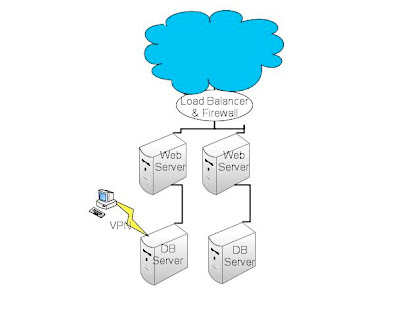
Secondly, since all traffic between your web/application servers and your database servers must be routed over the front end network it is difficult if not impossible to guaranty latency between those systems.  Even if they sit in the same data center, the latency can often be microseconds instead of milliseconds.  That just won't work for most traditional two tier architectures.

Now their have been many ingenious work arounds to the increased latency between cloud based systems.  That said, what would make the cloud much more accessible for enterprise is a way to create what I call Virtual Private Clouds within the public cloud.  Essentially it gives cloud users network level as well as systems level control on how their infrastructure is managed.  Cloud infrastructures would look much more like this:

Virtual Private Cloud

By creating true layer two connections between systems within the public cloud we solve three issues.

  1. Security - Any database servers can be disconnected from the public net.  This makes securing and locking down data much easier to do.
  2. Performance - By creating a VLAN within the Virtual Private Cloud, users can ensure layer two access between systems that sit on that VLAN.  That alloows for millisecond access times between systems and performance that mimics traditional hosted architectures.
  3. Network Based Management - This is the last benefit.  Right now to achieve functions like VPN's, Clustering, and custom Access Control Firewalls, cloud users have to provision open source "servers" to do the trick.  Virtual Private Clouds allow these functions to be migrated back in to the networking gear where the performance is much higher and the management is much simpler.

While we are seeing some of the elements of virtual private clouds in the cloud offering out there (GoGrid does allow you to configure network based clustering) most of the solutions are not truly cloud based, flexible, API driven offerings.  Instead they are virtual farms you order where the networks can be configured.  For the cloud to truly take off with corporate users, we'll need to see true cloud offerings with this type of network configurations.

Hadoop 101 by Chris Wensel

インターネット上のアプリケーションで大型のデータベースをサポートする際に、従来のRDB技術ではなく、BigTable(Google)やHadoop(Open Source)のような技術を採用するケースが増加。 


Hadoop 101 by Chris Wensel

What conversation about cloud computing is complete without a mention of big data, distributing processing, and distributed databases?  There is a recent trend away from relying exclusively on the traditional relational database for everything.  Newer technologies like BigTable and Hadoop provide an alternative mechanism for storing and processing large sets of data that don't necessarily have extensive relationships needing modeling.  These technologies allow for a much more scalable solution.

In fact, they help in two ways: one by allowing an application to process more data using horizontal scalability (aka 'elasticity') and two by reducing load on the primary relational database and hence allowing you to go longer before 'sharding'.

Chris Wensel is the man when it comes to understanding Hadoop and he recently gave a couple of talks introducing Hadoop.  Here is one of them:

Microsoft Hires Yahoo Data Center Executive, Nine Articles So Far

Microsoft社がYahooのデータセンタ責任者を採用したという記事が多く登場。 
Michaels Manos氏がMicrosoftを離れて、Digital Realty社に移った後の後任。

Microsoft Hires Yahoo Data Center Executive, Nine Articles So Far

Who would have thought there would would nine articles regarding Microsoft hiring the replacement for Mike Manos.  Must be a combination of Microsoft hiring another Yahoo executive.

Microsoft plucks Yahoo! data center efficiency expert

Register - ‎8 hours ago‎

Microsoft has hired a Yahoo! data center veteran to help build an energy efficient infrastructure beneath its planned cloud and online services. ...

Microsoft hires Yahoo data center exec Silicon Valley / San Jose ...

Bizjournals.com - ‎8 hours ago‎

Microsoft Corp. on Monday said it poached a top data center executive from rival Yahoo Inc. The Redmond-based software giant (NASDAQ:MSFT), in a blog post, ...

Microsoft nabs Yahoo data center executive

CNET News - Ina Fried - ‎11 hours ago‎

In his new role, Timmons will lead a data center services team, Microsoft infrastructure services general manager Arne Josefsberg said in a blog posting. ...

Microsoft Hires Key Yahoo Data Center Executive

ChannelWeb - Kevin McLaughlin - ‎7 hours ago‎

At Yahoo, Timmons led the buildout of Yahoo's data center strategy and has a reputation for placing great importance on the PUE (Power Usage Effectiveness) ...

Yahoo data center executive jumps to Microsoft

Ars Technica - ‎9 hours ago‎

Redmond has hired a former Yahoo Operations vice president to lead its Data Center Services team. Kevin Timmons today joined the Global Foundation Services ...

Microsoft Steals Away Another Top Yahoo

InternetNews.com - Stuart J. Johnston - ‎7 hours ago‎

In a posting on the MS Datacenters blog, the software giant announced it has hired Kevin Timmons, former Yahoo (NASDAQ: YHOO) vice president of operations, ...

Former Yahoo Exec Joins Microsoft

Web Host Industry Review - Justin Lee - ‎7 hours ago‎

Most recently serving as vice president of operations at Yahoo, Timmons led the build-out of the company's data centers and infrastructure. ...

Microsoft Hires Its Sixth Yahoo Exec (In Just Over Six Months)

paidContent.org - ‎11 hours ago‎

Timmons was the vice president of operations at Yahoo, where he led the build-out of the company's data centers and infrastructure. He had previously served ...

Kevin Timmons: Microsoft hires yet another Yahoo executive

TechWhack - ‎13 hours ago‎

Microsoft has announced the appointment of Kevin Timmons as the new head of their Data Center Services. He takes over from Michael Manos who had left the ...

Google News didn't have Rich Miller's Data Center Knowledge.

http://www.datacenterknowledge.com/archives/2009/06/22/microsoft-hires-yahoo-data-center-chief/