2009年2月7日土曜日

Cracking the code: Building Your SaaS Sales Compensation Plan

SaaSアプリケーションを販売する企業の営業組織のCompensation Planは従来の売り切り型のソフトウェアライセンス事業とは異なるCompensation方式を採用する必要がある。 
 
下記がその一例、としていくつかの企業で採用されている。
 

Compensating the sales force is a difficult task and the key is usually to keep things simple, so that each sales rep knows what he needs to optimize to make more money at the end of the quarter. For SaaS companies, we found that MRR is the best metric on which to base sales commissions. While it may make sense to offer very slight adjustments for favorable payment terms and one time revenue, net additions to MRR should dominate the sales rep's thoughts. The reps' top 3 priorities should be (i) MRR, (ii) MRR, and (iii) MRR.

I had the opportunity to exchange on this topic with Gary Messiana, a BVP Entrpreneur-In-Residence and former VP Sales and CEO of Netli and he shared with me the basic structure
he was using at Netli before the company was acquired last year by Akamai.
When he initially built the sales compensation plan, he wanted the sales rep to think MRR and the most logical thing to do was to give $1 of commission for $1 of MRR sold. $1 of MRR generates $12 of annual revenue, so $1 commission equals 1/12=8.3% which is very close to the typical 8% paid for sales commissions.

The second thing he did was to define was the ramp up of the commission rate to make sure the best sales rep would get the most upside. To do that, he applied another simple rule:
  • For 0-25% of the quota, $0.25 commision per $1 of MRR
  • For 25%-50% of the quota, $0.5 per $1 of MRR
  • For 50%-75% of the quota, $1.0 per $1 of MRR
  • For 75%+ of the quota, $1.5 per $1 of MRR

To avoid reps pushing deals from one quarter to the next, the quota was set annually and the compensation rules defined above were based on the annual target instead of a quarterly target. By doing this, the sales reps had a very high incentive to perform during the entire year.

Finally, he added a "continuity rule". As a CEO, Gary typically based his sales board plan at 70% of sales quota. To ensure he would make his number, he defined a "continuity rule" stating that a rep who is below 70% of its annualized target at any point in the year would be on a "B" plan where he basically gets nothing (may be half or 25% of the "A" plan" defined above).

This simple compensation plan structure worked very well at Netli. The company had the chance of selling a very sticky product to large customers paying upfront, so there was no need to improve the sales bonuses based on cash collection and multi-year contracts. The payment rules were also very straightforward: 50% at signature and 50% at cash collection.

To know whether it is worth adding more complexity to this sales comp plan, you need to ask yourself two questions:

  • Am I better off with a one year contract to preserve my ability to raise the price or do I need multi-year contracts to reduce the churn?
  • What is my cost of capital and how much is worth an incremental upfront payment?

Typically, if you churn is low (98%+ renewal rates), you will tend to favor one-year contract to preserve the flexibility of increasing prices and it is not worth adding incentives to extend the life of the contract. If not, you might want to add some acceleration in the incentive structure to push the sales of longer contracts. If you assume that the cost to renew a contract costs you 20% of the MRR, then adding increasing the commission by 10% for each additional year seems reasonable.

Accelerating bonuses for upfront cash payment depends on your cost of capital. If you assume a 20% cost of capital (typical for equity, debt is generally cheaper), then getting an upfront payment for one additional year on a $10k MRR contract saves you $24k. You can therefore pay an incremental $2k commission to the sales person (20% acceleration) and make it worth it for everyone.
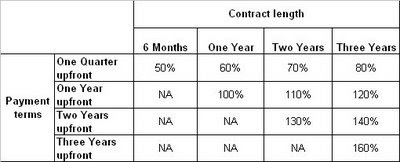
The table below gives you an example on how acceleration could work for a company willing to emphasize the focus on upfront cash payment and contract length:


As a SaaS company matures, it does not want to bog down its top performing sales reps with the job of renewing their growing account bases. So invariably the team splits into hunters for new accounts and farmers for renewals and upsells. Obviously, hunting takes more effort and resource than farming--the Vice-President Sales needs to determine the ratio between the two based on how easy it is to renew an account, and apply that ratio in the sales commissions. For example, $1 of MRR might generate $1 of commission for the first year, and 20 cents for each year of renewal. In this example, the new account sales rep can be compensated for longer term contracts by paying the "hunt commission" for year one and "farm commissions" for subsequent years (e.g. $1.20-1.40 for a three year contract). In this way, the rep will apply the proper attention to closing long term contracts where the risk of churn has been mitigated. Upsells are typically worth more than renewal and less than new customers so we found that 50% of new MRR worked pretty well.

For company with complex UI or usability issue, you might also want to add a small incentive to reward the sales of training module as this will impact churn, but this should be short term fix as your engineering team works hard to improve the product.

I hope this will give you the basic structure to help you build your SaaS sales compensation plan.

Column 2 : Appian Analyst Update

Appian社はBPMソリューションを提供するベンダーの一つ。  去年はSaaS事業への展開で成長を遂げているベンダーの一つで、StarbucksやManulifeなどの顧客を自社のSaaSアプリケーションAppian Anywhereでサポートしている。 

2008/4Qは売り上げが好調で、US Army等はログイン回数が10億回を超えるなど、ユーザの規模も大きくなってきている。 

同社はアプリケーションを軸として事業戦略を明確にしている。  従来のOn−Premise型のAppian Enterpriseに加え、2008開始のAppian AnywhereというSaaS版、さらに低価格バージョンとしてEC2-Hosted型のAppian Anywhereの3つのバージョンを全く同じソースコードで提供しながら、異なる価格帯、顧客層を対象として事業を展開している。 


Amazon EC2バージョンのAppian Anywhereは、30日無償トライアルが出来る事に加え、Single Tenantアーキテクチャを採用し、一ユーザあたり $35の価格で提供される。  EC2版で製品を試した後、自社SaaS型のAppian Anywhereへの移行が簡単に出来る。  3つの製品はコードベースが同じなので、顧客データも簡単に移行できる。 

同様に、自社プラットホーム上でアプリケーション開発を可能にする開発フレームワークを提供開始しており、3rdパーティがAppian Anywhere上でビジネスが展開できるインフラも提供している。 


Appian Analyst Update

Matt Calkins and Samir Gulati from Appian were on a short analyst call today to give us a summary of 2008 and a preview of 2009. They had some big changes this year: expanding their marketing efforts, launching their SaaS offering with customers like Starbucks and Manulife, and expanding geographically into Europe and Asia. Much of this is fuelled by the $10M in VC funding that they took on in 2008, the first external funding in their 10-year history; based on the timing of the funding, I'm guessing that they got a much better valuation than if it had happened a few months later.

Their sales numbers are counter-cyclical, with their Q4 in 2008 being their biggest closing quarter ever. Although they built their business on their US federal government business, they've broadened out to a number of commercial clients in financial services, manufacturing and other verticals. They've also seen some milestones with systems already in place, such as a total of 1B logins to the system that they have at the US Army. I think that they're just getting starting with BPM there, so this is likely mostly on their portal platform; still, that's a lot of logins.

Appian's big push in 2008 was their SaaS platform, Appian Anywhere, which is forming an estimated 30% of their new business. Currently, it's still only available to selected large customers in a dedicated and fault-tolerant hosting environment: in other words, not a multi-tenanted SaaS solution that you can just sign up for online at any time, but more like just having your BPM servers sitting in someone else's location. They'll be releasing a lower-end offering hosted on Amazon EC2 in early February, with 30-day free trials for small businesses, where each customer is hosted on their own instance. This is the same sort of configuration approach adopted by Intalio, as discussed in the comments on a post that I wrote for the BPM Think Tank; there are many who would say that this is not multi-tenancy, it's virtualization, and it doesn't provide the level of scalability (both up and down) that's needed for true SaaS. The subscription cost for Appian Anywhere on EC2 will be $35/user/month.

Regardless of the platform – on-premise Appian Enterprise, the high-end hosted Appian Anywhere, or the EC2-hosted Appian Anywhere – it's the same code base, so there shouldn't be a problem moving from one to another as the need arises. This also means that they're not trying to split their engineering team in three directions to serve three markets: it's all the same code.

At the same time as the EC2 launch, Appian will be launching an application framework to allow for faster development and deployment of vertical applications, and an application marketplace to provide applications developed by Appian or partners on a subscription basis. Some initial applications will be free, with others coming in at around $10/user/month on top of the base subscription price.

Appian's focus is on making BPM frictionless: allowing it to be purchased and deployed within an organization without all the usual hoopla that it takes for on-premise systems. I think that there could be some challenges ahead, however, with the lack of multi-tenancy causing additional administrative overhead and setting limits on how big (or small) you can get with your Appian Anywhere system and still have it be cost-effective all around.

Cash is the new black for cloud apps

Web2.0企業の多くは無償でアプリケーションを提供し、広告収入を柱とした事業モデルを主体としている。
成功する企業もあれば、収縮してしまうものも多い。
課金サービスを提供するベンダーが数社登場しており、特にWeb2.0ベンダー向けにSaaS型のサービスをしている点が特長。
Zuora社: 自社のZ-CommerceプラットホームをSaaSで提供し、Google AppEngine、Windows Azure、Amazon Web Service等のCloud Computing環境上のアプリケーションにサービスを提供する。 本格運用になったら有償になるが、それまでの開発、テスト期間は無償。
他に、Aria Systems、Vindicia、eVapt、MetraTech(Microsoft社にサービスを提供)
Amazon Web Serviceも課金サービスを行う大手の一つだが自社のeRetail事業と同様のモデルに限定される。


Cash is the new black for cloud apps

For a long time I've rued and railed against Web 2.0's dependence on indirect funding — primarily advertising — and the concomitant lack of an effective platform for cloud-based applications to make money from subscriptions and other pay-as-you-go business models. Whatever Chris Anderson says, you can't make money with free, not unless you actually end up selling something.

Thanks to current economic conditions, developers are finally starting to realize that the simplest way to generate cash is to bill customers (doh! — for more straight-talking advice from me on monetizing SaaS, check out this short video). Now, just in the nick of time, a company has introduced a developer-friendly way to build billing and payments into a Web-based application and instantly you wonder, why on earth did it take so long?

Zuora logoAnnounced yesterday and currently in private beta pending a full launch once deployment has ramped up, the Z-Commerce Platform from SaaS billing startup Zuora is a set of APIs that expose functions from the company's existing product set, Z-Billing, Z-Payments and Z-Force (the third of which is a subscription management console and quotes engine built on Salesforce.com's Force.com platform). The APIs can be embedded in any cloud service built on Amazon Web Services, Force.com, Google AppEngine or even Windows Azure, which can then call services within the Zuora product suite. Application builders will still have to buy the Zuora products to run the back-office services once their application goes live, but use of the API platform itself is free to developers while in the develop and test phase. Zuora provides toolkits for popular languages such as Java, .NET and PHP, there's a reference implementation ('Z-Store') and of course a community site, where developers can collaborate and share best practice.

I don't intend to denigrate the undoubted capabilities of other SaaS billing vendors such as Aria Systems, Vindicia, eVapt [disclosure: a recent client] and IP Applications — or even of more conventional vendors like MetraTech, which powers online billing for Microsoft's recently launched Online Services. But all of them take a traditional, project-based approach to implementation that means the usual to-ing and fro-ing before you can get anything up and running. Whereas Zuora lets developers work directly with its APIs, charging nothing until the service is ready to go into production. That's a major advance and one that means developers at last have a low-threshold option for including proper subscription management and collection in their pay-as-you-go applications. The API calls in the Z-Commerce Platform cover functions such as pricing management, account maintenance, usage metering, invoicing, adjustments and collections, plus a one-step 'suscribe now' call that registers an account, creates a subscription and collects the initial charge as a single, integrated process.

Of course some of those cloud platforms already have some form of billing capability, most notably Amazon DevPay and Force.com's Checkout. But they have the uncomfortable side-effect of leaving the developer even more locked-in to a specific platform, and in any case have typically been designed for a narrower range of use cases. I asked Zuora's CEO, Tien Tzuo, specifically about DevPay.

"Our feeling is Amazon is never going to build a billing system of the robustness that the market needs," he told me. "The vast majority of companies using Amazon have a different pricing model that Amazon's payment system doesn't support."

Zuora already has some charter customers it's been working with to fine-tune the platform — and a total of 70 customers in total acquired in 2008, which is not bad considering the company only launched in the first half of the year. But it will still have a battle on its hands to convert most developers, who assume that collecting a subscription is a simple process they can create from scratch in a few lines of code. That's why Tzuo is emphasizing that Zuora is selling a business solution (his blog yesterday was headlined Introducing the Business Cloud), rather than merely another layer of cloud technology. "A business cloud that's separate from a technology cloud is an important concept to bring out," he told me in a briefing late last week. Meaning, this is about commercial realities, which business-minded technologists and business managers are more likely to grasp than diehard developers.

That gives Zuora an education challenge to bring its customers up-to-speed with the nuances of its platform. "People don't have an intuitive feeling for how subscription businesses work because it's a newish concept," said Tzuo. A subscription catalog is not at all like a shopping cart, where you're just dealing with lots of distinct items. Subscriptions usually have different levels — basic, professional, advanced — plus add-on options, and customers often want to move from one level to another, or change their add-on choices, part-way through a subscription agreement. As a result, said Tzuo, "developers quickly get confused when they first get started." So when they sign up with Zuora they're offered a lot of help to understand the subscription business model, and how to manage aspects such as offering different packages, handling add-ons and upgrades, doing amendments, and so on.


Zuora.com's new Enterprise Cloud platform is designed to make it easier for developers to sell subscriptions to the cloud-based applications they create. Eventually, that could attract new developers and lead to a wider selection of cloud apps for your company.

Formed in 2007 by former Salesforce.com and WebEx execs, Zuora.com already markets business tools for cloud-based developers, including Z-Billing, Z-Payments and Z-Force (which integrates with Salesforce.com). But acording to CEO Tien Tzou, Zuora's "broader goal is to move any company with a services mindeset to create a subscription business model."

That's where the Z-Commerce Platform comes in. The free service is designed to ease the surprisingly difficult aspects of subscription payments and billing, so developers can focus on creating their applications. "We are the engine in the background that knows how to collect the money," Tzou says. Unlike with other systems, if a customer misses a month's payment, for example, the Zuora system knowes enough to double the bill the next month. "We make it all very easy," Tzou says.

Of course, many Platform-as-a-Service (PaaS) outfits include "stores" that offer billing and payment options. But Tzou says those proprietary solutions "are never flexible enough to handle all the different business models out there... We think payment has to be independent" and use public APIs.

The Z-Commerce Platform includes:

1. A new platform for powering commerce for Cloud developers
2. Access all the power of Z-Billing, Z-Payments, Z-Force
3. SubscribeNow() for 1-click order processing
4. Online API Documentation
5. Sandbox environment
6. Sample Code and Toolkits to quickly get started
7. New Z-Developer Community Site with Developer Support
8. Reference client Web store with full source code

Zuora_Z-Commerce_Platform
Online APIs Enable E-Commerce as Service

While the platform is free, actually using the company's other services costs 1% - 2% of all transactions that run through the system -- with volume discounts that can lower that percentage for heavy users. More to the point, making it easier to profit from their creations should lead to more developers creating more cloud apps. Tzou calls the platform an "engine to allow this industry to grow."

We can dream, can't we?

Verticals onDemand Continues Rapid Growth with Recent Customer Wins, Including JHP Pharmaceuticals

VBioPharma社は医療業界向けのCRMソリューションを提供するベンダー。  同社の製品である、Verticals onDemandは売れ行きが好調で、SaaSへの移行が進んでいる事を示している。 
 
JHP Pharmaceuticals社で採用されたケースにおいては、低い価格帯とユーザインタフェースの使いやすさ、さらに導入期間が非常に短かった事が評価されている。
 
VBioPharmaはSalesforce.comのForce.comプラットホーム上で開発されている。 


A sluggish economy has not hindered the growth of life sciences SaaS CRM provider, Verticals onDemand, which ended the last quarter by signing five more customers. Most recently, JHP Pharmaceuticals LLC, a privately owned specialty healthcare company focused on sterile injectable products, selected Verticals onDemand's VBioPharma™ SaaS CRM application and VInsights™ analytics product to support its national sales team.

JHP Pharmaceuticals National Sales Director, Chris Deluzio, worked with complex client/server CRM systems in previous positions at Johnson & Johnson and Bristol Myers Squibb so he knew what features were most important for the company's first CRM application. "We needed a more customizable and user-friendly system that would cost-effectively grow with our developing sales team. The product's unique flexibility made it a great fit for our organization," said Deluzio.

Verticals onDemand's new no-maintenance SaaS analytics and reporting solution, VInsightsTM, was also an important part of the solution for JHP. "Analytics are necessary in our prescription and branded generics business to evaluate and drive sales force targeting and effectiveness," continued Deluzio. "VInsights was a great option for us because of the low-cost and user friendliness – making it much easier for our reps and managers to take advantage of all the rich data available to them. VInsights really sealed the deal for us."

JHP also utilized Verticals onDemand's services team for implementation. "The Verticals onDemand team listened to our needs, worked with us closely, and had a very quick turnaround – finishing well ahead of schedule," added Deluzio.

VBioPharma is the life sciences industry's leading SaaS CRM solution and the only application to come pre-validated for PDMA and CFR Part 11 compliance. Built on the Force.com platform from salesforce.com, VBioPharma delivers all the advantages of the SaaS model, and provides complete life sciences functionality including:

  • physician and account profiling;
  • visual affiliations tracking;
  • call scheduling and route management;
  • call reporting and mobile call reporting with electronic signature capture;
  • full samples management; and,
  • data warehouse, analytics and reporting capabilities.

Verticals onDemand developed its SaaS CRM application to provide a cost-efficient alternative over legacy client/server CRM systems, now considered inflexible, complex, and overly expensive. VBioPharma is delivered as a reliable service over the Internet, accessible through any web browser, and completely customizable at no additional cost. In addition, it runs in a disconnected mode on smartphones, laptops, and tablet PCs to ensure maximum user adoption.

"JHP is a great example of the next-generation pharmaceutical company – ideally suited for a next-generation SaaS CRM application like VBioPharma," said Matt Wallach, executive vice president & general manager at Verticals onDemand. "As the only CRM application that scales both up and down for any size pharmaceutical organization or division, VBioPharma will efficiently support JHP now, with 35 users, and as it grows to 3,500 users or more."

"We just recently completed implementation and our regional managers have been ecstatic about all that the VBioPharma system has to offer," concluded Deluzio.

About JHP Pharmaceuticals, LLC

JHP, headquartered in New Jersey, is a specialty pharmaceutical company which manufactures and sells pharmaceutical products, primarily aseptic injectable products into the hospital segment, and provides contract manufacturing of sterile products for innovator pharmaceutical companies. JHP is a private company wholly owned by JHP Holdings, LLC whose equity owners are Morgan Stanley Principal Investments, Peter Jenkins and Stuart Hinchen.

About Verticals onDemand

Verticals onDemand is the leading provider of Software-as-a-Service (SaaS) CRM applications to the life sciences industry. Founded by software industry veterans, the company combines deep industry domain expertise, CRM deployment experience, and SaaS operations savvy with Force.com from salesforce.com, the world's first multitenant, on-demand platform. Verticals onDemand customers are achieving the fastest time to value through the deployment of fully functional CRM applications that are simple to deploy, inexpensive to operate, and provide a superior user experience.

Verticals onDemand is a privately-held company headquartered in Pleasanton, CA with offices in Boston, Chicago, New Jersey, New York, and Philadelphia. For more information and online product demonstrations, visit www.verticalsondemand.com.

Oracle puts a price on single-tenancy

Oracle社が自社のSaaS戦略の一つとして、Single Tenancy方式の新しいオプションをCRM OnDemandで提供する事を発表。
従来のマルチテナント方式=$70/ユーザ、シングルテナント方式=$125/ユーザの価格に加えて、シングルテナント方式でありながら、Oracle社のアップグレードやパッチスケジュールに従ったソフトウェアメンテナンスに沿ったプログラムを採用したもの。
OracleとSalesforceはSaaS型のSFMソリューションで競合する関係であるが、価格設定面でそれぞれ異なる構造を持っている。 また新たな価格帯が登場した事により、両社の比較が更に複雑になると考えられる。


Oracle puts a price on single-tenancy

Oracle today announced a new centrally managed single-tenancy option for its SaaS CRM OnDemand application, along with various other features including unlimited custom objects. Existing prices remain the same, at $70 per user per month for the multi-tenant version and $125 per user per month for the previously available single-tenant enterprise version, which is a completely independent instance for which the customer can dictate its own upgrade and patch schedules.

Anthony Lye, SVP of Oracle CRM OnDemandThe new 'standard' single-tenancy option comes in at $90 per user per month. It's still a dedicated server but, unlike the 'enterprise' option, Oracle decides when it gets patched and upgraded. "You can get your own stack of the application but we'll still manage it and maintain it on our standard schedules," Oracle's SVP of CRM OnDemand Anthony Lye (pictured) explained to me in a briefing late last week.

What's the benefit? Lye says that it's having single-tenant instances of each component of the application stack, including the database, enabling benefits such as custom performance tuning. He calls this option a 'sweet spot', perhaps reckoning that most customers will be happy to stump up this small extra delta to have a server (even if only a virtual one) that they can call their own.

What I found interesting is the way Oracle has effectively put a price-tag on single-tenancy, all other things being equal in terms of shared management and data center infrastructure — and it's set it at $20 per user per month. Assuming Oracle is operating on the same gross margins as Salesforce.com, that suggests the vendor has calculated the extra cost of managing separate instances at just a few dollars per user per month more than the multi-tenant version. But that may not be a viable assumption, because the single-tenancy option has a minimum of 350 users, so maybe Oracle has calculated that it breaks even once it's covered a cost of $7,000 per server per month.

The other consideration here though is that Oracle's pod system, which runs its multi-tenant instances on small clusters that often have slight variations from one another, isn't multi-tenancy as practised by the SaaS purists. Lye points out that Oracle's pod infrastructure can never succumb to the kind of total outage that Salesforce.com's servers sometimes undergo. "I'm patching and upgrading the infrastructure seven days a week. I'm just not doing it all at the same time." But the SaaS purists would argue that by doing so, Lye misses out on some of the most significant economies of scale of the multi-tenant model.

Lye's riposte is to claim that Salesforce.com adds on so many extra charges it works out far more expensive for customers. "We're not nickle-and-diming our customers here," he said. In illustration, he pointed out that in its new release, the CRM OnDemand application, with business intelligence, sandbox testing, disaster recovery and unlimited custom objects, costs $160 per user per month; whereas he has calculated an equivalent set of functions from Salesforce.com — including a third-party BI tool — would cost more than $400 per user per month.

Software as Services / Tue, 27 Jan 2009 23:33:05 GMT


Oracle is hoping to challenge Salesforce.com's lead in the realm of CRM software-as-a-service products.
Oracle is expected Tuesday to unveil its CRM On Demand Release 16. The software was designed to offer customers more flexibility in deployment and maintenance than what's typical of the traditional SaaS model.


With the new release, Oracle hopes to demonstrate that it can offer companies more options in SaaS CRM than marketplace leader Salesforce, which abides by the multitenant model.
Oracle has offered both a multitenant version of CRM, in which customers share servers and software, for $70 a month per user, and a single-tenant version, in which customers rent their own hardware and software and can control maintenance upgrades, for $120 a month.

With Release 16, Oracle is adding yet another option: a single-tenant standard edition, in which companies pay a monthly fee to rent their own, nonshared systems, yet must abide by Oracle's CRM On Demand schedule for maintenance and upgrades, priced at $90 a user per month. A fourth option lets customers run CRM On Demand on systems located at their own offices for $110 a month per user.

Also with Release 16, Oracle has opened up customization options and said customers can now configure as many custom objects as they like for such things as data analysis, fields customization, and data integration; previously, customers were limited to three custom objects per system.

Oracle develops pre-built objects for specific industries but had limited custom object development since it assumed most users wanted an "out-of-the-box" SaaS experience, senior VP Anthony Lye said in an interview. Oracle still offers pre-built objects, but has found that customers want more options in customization, he said.

These changes to CRM On Demand, which are made twice yearly, emphasize Oracle's philosophy that SaaS can be an animal of many shapes and forms, depending on customer preferences. As Oracle's SaaS strategy evolves, it's decided to "listen to customer requirements more than dictate them," Lye said.

For example, some companies may insist on their own hardware and software and have no problem abiding with Oracle's maintenance schedule, and would choose the $90-per-month option. However, a company that wants to dictate maintenance so it can avoid any changes during a transaction-heavy time period -- say, the open-enrollment period for a health insurance provider -- and also have its own software and hardware may opt for the $120-per-month choice.

Lye said that within the past few years, Oracle has developed application and database "pods" of both multitenant and single-tenant CRM On Demand systems in its data centers, so that if one pod fails, other customers aren't impacted.

The result, Lye said, is that you'll never see a worldwide outage that affects every CRM On Demand customer. And customers that want hosted CRM but don't want to share with others can have their own exclusive pod.

With the multi-/single-tenant approach, "what Larry [Ellison] has created is sort of a Hertz business, where we have a whole fleet of vehicles," explained Lye. "Some are buses, some are hyperperformance vehicles, and some offer fuel economy. What Marc [Benioff, Salesforce's CEO] has is a big mainframe."

In any case, all of Oracle's CRM On Demand options avoid the traditional -- and increasingly controversial -- software license and maintenance model, which InformationWeek examines in our cover story this week. Oracle president Charles Phillips emphasized to InformationWeek in a recent interview that Oracle supports both the traditional model and the SaaS model for all of its customers.

Intacct wins converts with help of its channel

SaaS系の会計プログラムのベンダーとして代表的なのは、Intaact社、NetSuite社、Workday社の3つであるが、Intaact社が新機能を発表し、グローバル企業が世界中にもつの会計情報を集中管理、レポーティングできるソリューションを提供する事が可能になった。 これはNetSuite社やWorkday社も提供している機能で、SaaSのようにインターネットを経由したサーバでデータを集約できるアーキテクチャならではの機能となる。
 
既に3000社がこの機能を採用しており、中にはOracle Financialsからの移行を行っている企業も多い。  すべての導入コストがOracleの保守費の3/4程度で済むため、価格的な魅力が大きい。  また、Intaact社は販路開拓にも積極的で、全体の売り上げの5割を占めている。  特に他社からの移行作業を$2000の定額で提供している事も顧客への魅力となっている。 


Intacct wins converts with help of its channel

One facet that's becoming a distinctive, default feature for SaaS financials apps is real-time drill-down into consolidated global operational finance data — such as, who are my ten biggest debtors worldwide, or what's the dollar value of my sales pipeline in Southern Europe this week? With yesterday's announcement of Intacct's latest release, I've now seen this from all three of the big-name pureplay SaaS financials vendors [disclosure: Intacct is a current client]. NetSuite brought this capability live last year with its One World edition, and it has always been one of the core attributes of Workday's proposition. Like Workday, Intacct has coupled this with a new Flex-based user interface (see partial screenshot below).

Real-time global consolidation is distinctive for SaaS because, as Intacct's SVP of marketing, Dan Druker, wrote on his blog for the announcement, "because we are SaaS, we can assume that all financial data for every business entity, in every location and in any accounting regime or currency is always available on-line and real-time … in a flat world connected by the Internet, the days and weeks it used to take to run a consolidation and reporting cycle collapses into seconds and minutes."

With conventional software, this kind of capability is only available at huge additional expense, but it comes standard with SaaS. That's a tremendous competitive advantage for SaaS vendors aiming to win over midmarket customers. As I wrote last spring of NetSuite's OneWorld offering:

"Business decision-makers in today's highly connected world feel a pressing need to have access to accurate, real-time data when they make decisions, and conventional midmarket business software doesn't give them that, especially if they operate internationally or across multiple business units … [E]ach separate business operation has its own business systems and the data from each system has to laboriously aggregated at the end of each month before it can be evaluated. This time lag is going to be even more keenly felt now that everyone is nervous about the effects of the credit crunch. If your sales have suddenly reversed the rising trend of the past few years, you need to know that straight away, not six weeks after the fact."

More than a thousand of Intacct's 3,000 or so customers use its multi-entity and multi-currency capabilities (in fact, if it wanted to play a numbers game, it could claim "more than 10,000 businesses" in its customer base, taking into account separate entities within these customers). All of them will now be able to take advantage of the global consolidation function, which allows users to drill down from the global view to any individual record or transaction, and permits instant reporting and analysis of virtually any permutation of real-time data.

Thanks to this kind of capability — together with a longstanding strength in core financials and reporting — Intacct is now starting to win over its first Oracle Financials converts. The savings such customers can realize are pretty impressive — even though that's a clear signal these companies should probably should never have been sold the Oracle package in the first place. "The full subscription cost of Intacct for these companies is between a half and three-quarters of just the maintenance price for Oracle," Druker told me. As in many such cases, that means the customer effectively can Switch to SaaS for free.

At the other end of the scale, Intacct is also aggressively looking to pick up more Intuit QuickBooks converts. The friendlier user interface is one aspect of this, but Intacct is letting the money do most of the talking. It has cut its entry-level price in half to $400 per month per company, and has worked with partners to establish a fixed-price migration service that starts at $2000, which is anything from two-thirds to four-fifths less than what partners were charging before.

Druker also attributed partners the credit for Intacct's Oracle successes and noted that 50 percent of the company's new business came via the channel this past year. This is further evidence that the SaaS channel is thriving, where providers have the right strategy. The final element in the Intacct story is its MAX ecosystem of certified SaaS solutions that integrate with the financials package. To some extent such linkages are a necessity for a best-of-breed player that doesn't offer other applications (yesterday it announced a new partnership with professional services automation vendor QuickArrow). But it also dovetails well with the channel development strategy, as one of the big opportunities for partners is to be the first point-of-call for customers who want to implement integrated business processes across multiple SaaS applications.

One final sign that SaaS financials have arrived is the willingness of mainstream computer magazines to review them alongside conventional software packages. PC Magazine has just published a review of Intacct's fall 08 edition (one of the perils of print publishing of course is that your reviews of on-demand applications are always one edition behind), recommending it as a good midrange accounting product for those migrating from QuickBooks. Now wonder, as fellow Enteprise Irregular Vinnie Mirchandani noted, Druker's presentation finished with a slide entitled Life is Good.


Software as Services / Tue, 27 Jan 2009 10:45:30 GMT

Sent from FeedDemon

Xactly buys rival Centive

Sales Performance Managementアプリケーションという分野があり、SaaS事業としてこのアプリケーションのベンダーである2社、Xactly社、Centive社が合併する、という記事。
 
Centive社はADP社へのOEM提供も行っている


Xactly buys rival Centive

Xactly last night announced it has completed the acquisition of Centive, its closest pureplay SaaS rival in the sales performance management sector. The all-stock deal almost doubles San Jose-based Xactly's revenue and customer base, and had first been discussed by the two CEOs as much as a year and a half ago, Xactly's CEO Chris Cabrera told me this morning. Having eliminated the distraction of competing with each other, the combined company will now be able to focus on winning market share from conventional and hybrid-SaaS competitors such as Callidus Software. "We think that by taking the only two 100-percent SaaS companies in the game and making them one, we make it easier for our customers to choose," said Cabrera.

Chris Cabrera, founder and CEO of XactlyWhen asked whether current economic conditions had played a part in crystallizing the acquisition, Cabrera was at pains to assert that both companies had been doing well independently. "Both companies had a very good Q4 — our space is doing very well," he said. "By combining these two companies together we come so much more of a strong competitor." New Centive customers in 2008 included over 1000 seats at a division of Motorola, and several hundred seats each at Flowserve, Honeywell, Intergraph, Parametric and WebSense, while Xactly recorded notable wins at 3Com, NTT America, Omniture, PayPal, Rackspace, TIBCO and others. The combined company now has "well over 200 customers" said Cabrera.

"Size really matters in the SaaS world," he added, noting that the acquisition will bring operational savings as back-office functions are merged, helping reduce costs as a proportion of revenue — although the company will retain a significant presence in New England, where Centive has its headquarters. "Doubling in size helps us get there much more quickly," said Cabrera. "This really was a no-brainer from a financial point of view."

Convergence of the two product sets won't begin until the company has had time to evaluate how best to bring them together. Although there's inevitably a great deal of overlap, there are areas of functionality that are unique to each and so it won't be a case of completely eliminating one product, as has been seen in some other SaaS acquisitions recently. Xactly will also be seeking to preserve and build on Centive's OEM partnership with ADP, which has brought in contracts ranging from 70 to 650 seats since it was announced in late 2007.

The combined company has significant venture capital backing. According to peHUB, Xactly has raised $60 million since 2005, while Centive has raised over $96 million in the past ten years, although MassHighTech notes that $80 million of that sum predates a recapitalization that took place in 2005, prior to Centive selling off its on-premise software business to private equity investors.


Software as Services / Fri, 23 Jan 2009 19:30:24 GMT

Sent from FeedDemon