ラベル Cloud Computing definition の投稿を表示しています。 すべての投稿を表示

2008年7月19日土曜日

Cloud Computingの定義

Cloud Computingの定義について、各界の著名人20人が述べたコメントを整理した記事。 技術的な観点で解説する人がいる一方、マーケティングキーワードとして片付けている人も多い。

Twenty Experts Define Cloud Computing

It is the infrastructural paradigm shift that is sweeping across the Enterprise IT world, but how is it best defined? I refer of course to 'Cloud Computing' - the phenomenon that currently has as many definitions as there are squares on a chess-board. To try and narrow it down we bring here a round-up of some recent attempts to bring welcome precision where there risks being unnecessary vagueness. Enjoy!


"What is cloud computing all about? Amazon has coined the word "elasticity" which gives a good idea about the key features: you can scale your infrastructure on demand within minutes or even seconds, instead of days or weeks, thereby avoiding under-utilization (idle servers) and over-utilization (blue screen) of in-house resources. With monitoring and increasing automation of resource provisioning we might one day wake up in a world where we don't have to care about scaling our Web applications because they can do it alone."

Markus Klems

"Cloud computing is one of those catch all buzz words that tries to encompass a variety of aspects ranging from deployment, load balancing, provisioning, business model and architecture (like Web2.0). It's the next logical step in software (software 10.0). For me the simplest explanation for cloud computing is describing it as, "internet centric software".

This new cloud computing software model is a shift from the traditional single tenant approach to software development to that of a scalable, multi-tenant, multi-platform, multi-network, and global. This could be as simple as your web based email service or as complex as a globally distributed load balanced content delivery environment.

I think drawing a distinction on whether its, PaaS, SaaS, HaaS is completely secondary, ultimately all these approaches are attempting to solve the same problems (scale). As software transitions from a traditional desktop deployment model to that of a network & data centric one, "the cloud" will be the key way in which you develop, deploy and manage applications in this new computing paradigm."

Reuven Cohen

"I view cloud computing as a broad array of web-based services aimed at allowing users to obtain a wide range of functional capabilities on a 'pay-as-you-go' basis that previously required tremendous hardware/software investments and professional skills to acquire. Cloud computing is the realization of the earlier ideals of utility computing without the technical complexities or complicated deployment worries."

Jeff Kaplan

"I think 'Clouds' are the next hype-term for the next year or two. People are coming to grips with Virtualization and how it reshapes IT, creates service and software based models, and in many ways changes a lot of the physical layer we are used to. Clouds will be the next transformation over the next several years, building off of the software models that virtualization enabled."

Douglas Gourlay

"The way I understand it, "cloud computing" refers to the bigger picture…basically the broad concept of using the internet to allow people to access technology-enabled services. According to Gartner, those services must be 'massively scalable' to qualify as true 'cloud computing'. So according to that definition, every time I log into Facebook, or search for flights online, I am taking advantage of cloud computing."

Praising Gaw


See next page
for definitions from Damon Edwards, Brian de Haaff, Kirill Sheynkman, Ben Kepes, Omar Sultan, Kevin Hartig, and Yan Pritzker
See final page for for definitions from Trevor Doerksen, Thorsten von Eicken, Paul Wallis, Michael Sheehan, Don Dodge, Aaron Ricadela, and Irving Wladwasky Berger.

"Clouds are the new Web 2.0. Nice marketing shine on top of existing technology. Remember back when every company threw some ajax on their site and said "Ta da! We're a web 2.0 company now!"? Same story, new buzz word.

On the positive side, the Web 2.0 concept did catch the mainstream's eye and made them aware of the possibility of collaborative web services. Similarly, the "Cloud" concept is finally wrapping peoples' minds around what is possible when you leverage web-scale infrastructure (application and physical) in an on-demand way. "Managed Services", "ASP", "Grid Computing", "Software as a Service", "Platform as a Service", "Anything as a Service"… all terms that couldn't get it done. Call it a "Cloud" and everyone goes bonkers. Go figure."

Damon Edwards


"There sure is a lot of confusion when it comes to talking about cloud computing. Yet, it does not need to be so complicated. There really are only three types of services that are cloud based: SaaS, PaaS, and Cloud Computing Platforms. I am not sure being massively scalable is a requirement to fit into any one category."

Brian de Haaff


"SaaS is one consumer facing usage of cloud computing. While it's something of a semantic discussion it is important for people inside to have an understanding of what it all means. Put simply cloud computing is the infrastructural paradigm shift that enables the ascension of SaaS."

Ben Kepes


"The 'cloud' model initially has focused on making the hardware layer consumable as on-demand compute and storage capacity. This is an important first step, but for companies to harness the power of the cloud, complete application infrastructure needs to be easily configured, deployed, dynamically-scaled and managed in these virtualized hardware environments."

Kirill Sheynkman


"I was chatting with a customer the other day who was struggling with some of the implications of cloud computing. The analogy that finally made sense to them is what I will call 'cloud dining.' I am the cook in the house and I am tasked with feeding the family. If my 10-year old is lobbying for Italian, I am cook at home or order out. The decision may also vary from day to day. For instance, I might not have all the ingredients and have to order out, or, like this weekend, it may be 103 outside and cooking at home is not all that appealing. Now, the same can be said for supporting a given application in a cloud computing environment.

In a fully implemented Data Center 3.0 environment, you can decide if an app is run locally (cook at home), in someone else's data center (take-out) and you can change your mind on the fly in case you are short on data center resources (pantry is empty) or you having environmental/facilities issues (too hot to cook). In fact, with automation, a lot of this can can be done with policy and real-time triggers. For example, during month end processing, you might always shift non-critical apps offsite, or if you pass a certain cooling threshold, you might ship certain processing offsite."

Omar Sultan


"Cloud computing overlaps some of the concepts of distributed, grid and utility computing, however it does have its own meaning if contextually used correctly. Cloud computing really is accessing resources and services needed to perform functions with dynamically changing needs. An application or service developer requests access from the cloud rather than a specific endpoint or named resource. What goes on in the cloud manages multiple infrastructures across multiple organizations and consists of one or more frameworks overlaid on top of the infrastructures tying them together.

The cloud is a virtualization of resources that maintains and manages itself."

Kevin Hartig

"Clouds are vast resource pools with on-demand resource allocation. The degree of on-demandness can vary from phone calls to web forms to actual APIs that directly requisition servers. I tend to consider slow forms of requisitioning to be more like traditional datacenters, and the quicker ones to be more cloudy. A public facing API is a must for true clouds.

Clouds are virtualized. On-demand requisitioning implies the ability to dynamically resize resource allocation or moving customers from one physical server to another transparently. This is all difficult or impossible without virtualization.

Clouds tend to be priced like utilities (hourly, rather than per-resource), and I think we'll see this model catching on more and more as computing resources become as cheap and ubiquitous as water, electricity, and gas (well, maybe not gas). However, I think this is a trend, not a requirement. You can certainly have clouds that are priced like pizza, per slice."

Jan Pritzker


See next page for definitions from Trevor Doerksen, Thorsten von Eicken, Paul Wallis, Michael Sheehan, Don Dodge, Aaron Ricadela and Irving Wladawsky Berger


"Cloud computing is ... the user-friendly version of grid computing."

Trevor Doerksen

"Most computer savvy folks actually have a pretty good idea of what the term "cloud computing" means: outsourced, pay-as-you-go, on-demand, somewhere in the Internet, etc."

Thorsten von Eicken


"In order to discuss some of the issues surrounding The Cloud concept, I think it is important to place it in historical context. Looking at the Cloud's forerunners, and the problems they encountered, gives us the reference points to guide us through the challenges it needs to overcome before it is adopted."

Paul Wallis


"I would like to propose a 'Cloud Pyramid' to help differentiate the various Cloud offerings out there. [At the top of the pyramind] users are truly restricted to only what the application is and can do. Some of the notable companies here are the public email providers (Gmail, Hotmail, Quicken Online, etc.). Almost any Software as a Service (SaaS) provider can be lumped into this group.

As you move further down the pyramid, you gain increased flexibility and control but your a still fairly restricted to what you can and cannot do. Within this Category things get more complicated to achieve. Products and companies like Google App Engine, Heroku, Mosso, Engine Yard, Joyent or force.com (SalesForce platform) fall into this segment.

At the bottom of the pyramid are the infrastructure providers like Amazon's EC2, GoGrid, RightScale and Linode. Companies providing infrastructure enable Cloud Platforms and Cloud Applications. Most companies within this segment operate their own infrastructure, allowing them to provide more features, services and control than others within the pyramid."

Michael Sheehan


"The web fanatics and blogosphere would have you believe that all applications will move to the web. Some will, most will not. Reliability, scalability, security, and a host of other issues will prevent most businesses from moving their mission critical applications to hosted services or cloud based services. The risk of failure is too great.

Amazon is the leader in cloud based services, but even Amazon has experienced down times for its own business. Cloud services will continue to improve. But my guess is the uptake will take longer than most people predict."

Don Dodge

"Today's combination of high-speed networks, sophisticated PC graphics processors, and fast, inexpensive servers and disk storage has tilted engineers toward housing more computing in data centers. In the earlier part of this decade, researchers espoused a similar, centralized approach called "grid computing." But cloud computing projects are more powerful and crash-proof than grid systems developed even in recent years."

Aaron Ricadela

"When virtualizing applications to be used by people who care nothing about computers or technology - as is mostly the case with Clouds - the key thing we want to virtualize or hide from the user is complexity. Most people want to deal with an application or a service, not software. ... The more intelligent we want [computers and computer applications] to be - that is, intuitive, exhibiting common sense and not making us have to constantly take care of them - the more smart software it will take. But with cloud computing, our expectation is that all that software will be virtualized or hidden from us and taken care of by systems and/or professionals that are somewhere else - out there in The Cloud."

Irving Wladawsky Berger


"I view cloud computing as a broad array of web-based services aimed at allowing users to obtain a wide range of functional capabilities on a 'pay-as-you-go' basis that previously required tremendous hardware/software investments and professional skills to acquire. Cloud computing is the realization of the earlier ideals of utility computing without the technical complexities or complicated deployment worries."

Ben Kepes

Cloud Computingの定義

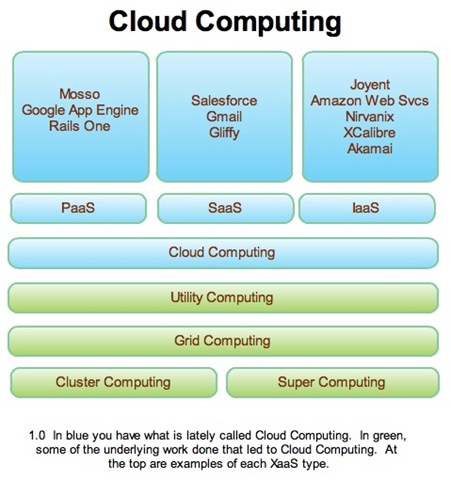
Cloud ComputingさらにSaaS、PaaS、IaaSの定義について簡単な定義を説明し、関連するベンダーを列挙した記事。 さまざまなキーワードをレイヤー的に整理しているところが面白い。

Cloud Computing: Get Your Head in the Clouds

Almost every day recently I find myself explaining Cloud Computing to different people at all levels and roles in various organizations. So, I decided to take a stab at it from my point of view. The challenge in explaining cloud computing is that there is more than one answer to the what is it question. The field is evolving rapidly and everyone wants a piece now. This article attempts to define and break down cloud computing to it's most important components in the context of the business use case. This article is for the potential cloud computing consumer. So, what is cloud computing?

Cloud Computing (Figure 1.0) is a commercial extension of computing resources like computation cycles and storage offered as a metered service similar to a physical public utility like electricity, water, natural gas, or telephone network. It cloudcomputinggraphic.jpegenables a computing system to acquire or release computing resources on demand in a manner such that the loss of any one component of the system will not cause total system failure. Cloud computing also allows the deployment of software applications into an environment running the necessary technology stack for the purposes of development, staging, or production of a software application. It does all this in a way that minimizes the necessary interaction with the underlying layers of the technology stack. In this way cloud computing obfuscates much of the complexity that underlies Software as a Service (SaaS) or batch computing software applications. To explain better though, let's simplify that and break it down this definition to it's constituent parts.

More compactly stated, cloud computing is a commercial extension of utility computing that enables scalable, elastic, highly available deployment of software applications while minimizing the level of detailed interaction with the underlying technology stack itself.


Definitions of Necessary Terms to clarify and define cloud computing:

Utility Computing - The combination of computing resources as a metered service in a way similar to a physical public utility.

Scalability - The ability of a computing system to grow relatively easily in response to increased demand

Elasticity - The ability of a system to dynamically acquire or release compute resources on-demand

Highly Available - Systems designed such that the loss of any one component of a system will not result in system failure

Deployment - Placing your software application into a technology stack in a running environment for development, testing, or production

Software Application - An arrangement of programming code designed to achieve some specific purpose

Technology Stack - The Hardware and Software layers underlying a given software application. Figure 1.1.

generictechstack.jpeg

Now we know what cloud computing is and that's great. But, I'll let you in on a little secret. For most people, it just doesn't matter! Remember, we're talking about cloud computing in the context of business. We're not talking about buzz words, technobabble, or hope. Let's get to the really important question. How can all this cloud computing alphabet soup help my business or my idea flourish? Starting again with that question and keeping it in mind at all times you and your technology team can make pragmatic decisions over time. You may have heard it before, and it bears repeating, that there is no place in day to day businesses for technology for technologies sake alone in most companies. Technology, cloud related or otherwise, has to make good business sense to make any sense at all.

To decide if cloud computing can help your idea or business flourish you have to decide what type of service provider you need. There are three distinct sub-areas of cloud computing. They are IaaS, PaaS, and SaaS. We will define and discuss these in turn.

Infrastructure as a Service (IaaS)

IaaS clouds make it very easy and affordable to provision resources such as servers, connections, storage, and related tools necessary to build an application environment from scratch on-demand. IaaS clouds are the underlying infrastructure of PaaS and SaaS clouds. A common characteristic of IaaS clouds is that they are more complex to work with but with that complexity comes a high degree of flexibility. So, these are generally lower level services in the grand scheme of things; not in a derogatory sense of course. You'll be dealing with virtual machines, operating systems, patches, and various other issues. You'll likely require some specialized help to make it all work well.

Some current examples of these types of services are (some of these are hybrids too but I put them where the most belong in my opinon).

Amazon Web Services - Extremely flexible Build your own w/ many add-ons
VMWare - Build your own
Elastra - Up an comer build and manage your own IaaS
3Tera - Sexy GUI based IaaS/PaaS building tools
Xen - Build your own
XCalibre - Very interesting and can do Linux or Windows
Nirvanix - All about cloud storage, very interesting subset similar to Amazon S3
EngineYard - Rails only Build your own
Joyent - Build your own on Solaris w/ Java/PHP/Rails/Python

The number one benefit of such services is rapid provisioning. You will not have to wait days, weeks, or months for new servers. In some cases, you can have them in minutes! In fact, it's so easy to provision that it's easier to just throw away "broken" servers and replace them with new instances in most cases. All the details of provisioning, racking, stacking, cabling, and more are completely abstracted away from you.

The developers of applications for such systems will often need to adjust things to accommodate for the IaaS cloud. It can also be somewhat difficult to move from one cloud to another in some cases. But, less so with IaaS clouds than the PaaS clouds we will discuss next.

Billing for these services is usually incremental by use and can get complex with tiered on-demand pricing that can be difficult to track in real time. Pricing is usually well defined but can be rather difficult to forecast in some cases. It can vary to the minute depending on levels of use, tiers of service, and other interesting combinations. Now, on to the second type of cloud computing model that's important in the context of this article.

Platform as a Service (PaaS)

PaaS clouds are designed, often within IaaS Clouds by experts to make the deployment and scalability of your application trivial and your costs incremental and reasonably predictable. Here are a few of the choice Application Stack Cloud Providers (ASCP) in this space today.

Mosso, PHP, .NET, Java, Rails, Python, other?
Google App Engine, Python
SalesForce - Proprietary
Morph - Ruby on Rails
Heroku - Ruby on Rails

There are more and more PaaS clouds sprouting up constantly and rapidly. The number one benefit of such a service is that for very little money, none in some cases, you can launch your application with little effort beyond having developing and and possibly some porting work if it's an existing application. Additionally, there will be a large degree of scalability built into your PaaS choice by design as it is a cloud as defined earlier in the article. Finally, you will not need to hire a professional systems administrator more than likely as they are part of the service itself. If you are trying to keep your operations staff lean this can be a useful path to follow assuming your application will capitulate.

The number one down side of choosing an PaaS Cloud provider is that all such services come with various restrictions or trade-offs that may be a non-starter for your project. This is especially true of you already have a pre-existing application that might need to be ported to the PaaS solution you choose. You will need to plan on some porting development time costs and it might not be trivial. For example, a particular PHP extension, rails gem, or operating system tool may be unavailable that your application needs and you'll have to code around these types of issues as your ability to add this to an Application Platform Cloud will be limited unless it's a custom PaaS.

Billing for these services varies. It can be by the hour, request, CPU cycle, or other creative ways. Some even help you do pass through billing for your customers; like Mosso. But, the defining factor in pricing of Application Platform Clouds is that they generally strive to be robust, simple, and easy to load your application into when you are ready.

Software as a Service (SaaS)

Software as a Service has been around for a while now and actually precedes the newer term Cloud Computing. What's interesting, and the reason to include SaaS in this article is that Cloud Computing is breathing ever more life into the SaaS model by reducing the costs associated with producing a SaaS application. A couple of well known examples of SaaS are GMail or Salesforce.

SaaS is not really the ultimate goal of Cloud Computing per say but it is an important, relevant, and right now step along the evolution of compute resource management and allocation.

In summary, understanding cloud computing requires some base knowledge and historical review to know where it came from. This will enlighten people that it's not exactly new but that there is a new excitement now due to technology and business convergence. Once you have that base, which you now do, explicitly learning to use the cloud is the next step. Then, you can almost certainly implement your ideas faster, cheaper, and more profitably than people have ever been able to do before. It's a very exciting time to be in computing and in fact, to be on this planet. Welcome to the clouds!

2008年7月18日金曜日

Cloud Computingの新たな定義

SYS-CON誌の記者が書いたCloud Computingを整理しようとした記事。
基本的に、SaaSという上位のレベルにPaaSのレイヤーをAPIのあるものと無いものとに分けて、合計3つのレイヤーを定義した内容になっている。
市場での理解が段々と共通化していく状況が見えてきており、日本市場の成長もこれに添った形になっていくのでは、と考える。

Cloud Computing: Introducing the Cloud Pyramid

I would like to propose a 'Cloud Pyramid' to help differentiate the various Cloud offerings out there.

This insightful post by Thorsten von Eicken recently got me thinking. The term "Cloud Computing" is much too vague. People want and need "slots" or "segments" where they can group things. This is how the mind operates through categorization and ordering. So, to possibly help with this, I would like to propose a "Cloud Pyramid" to help differentiate the various Cloud offerings out there.

Cloud Pyramid

There are other ways to display this hierarchy, however I elected to show it as a pyramid. For example, if one were to weight the graphic by the number of providers within each segment, the pyramid would be upside-down. The point here though is to show how these cloud segments build upon and are somewhat dependent upon each other. While they are directly related, they don't require interdependence (e.g., a Cloud Application does not necessarily have to be built upon a Cloud Platform or Cloud Infrastructure). I would propose, however, that Cloud trends indicate that they will become more entwined over time.

Cloud Application

Within this part of the pyramid, users are truly restricted to only what the application is and can do. Some of the notable companies here are the public email providers (Gmail, Hotmail, Quicken Online, etc.). Almost any Software as a Service (SaaS) provider can be lumped into this group. Most retail consumers use the services within this Cloud. You get pre-defined functionality and you cannot much further than that. Applications are designed for ease of use and GTD (getting things done). SalesForce, a huge Cloud Application/SaaS provider that has led the way for hosted software, falls into this category as well, however, their force.com product does not. Even online banking offerings could be lumped into this group.

Characteristics:

  • Strengths
    • Sometimes free; easy to use; lots of different offerings; easy to access; good consumer adoption; proven business models
  • Weaknesses
    • You can only use the application as far as what it is designed for; no control or knowledge of underlying technology

Cloud Platforms

As you move further down the pyramid, you gain increased flexibility and control but your a still fairly restricted to what you can and cannot do. Within this Category things get more complicated to achieve. Products and companies like Google App Engine, Heroku, Mosso, Engine Yard, Joyent or force.com (SalesForce platform) fall into this segment. This category is becoming more congested with competitors, many of whom are trying to leverage the Cloud Infrastructure.

Characteristics:

  • Strengths
    • Great for developers with a particular niche target, upload a tightly configured applications and it simply "runs"; more control than a Cloud Application
  • Weaknesses
    • Restricted to the platform's ability only; hard to work "outside the box"; sometimes dependant on Cloud Infrastructure providers

Cloud Infrastructure

At the bottom of the pyramid are the infrastructure providers like Amazon's EC2, GoGrid, RightScale and Linode. Companies providing infrastructure enable Cloud Platforms and Cloud Applications. Most companies within this segment operate their own infrastructure, allowing them to provide more features, services and control than others within the pyramid. And at this foundation level, GoGrid offers infrastructure in the form of both Linux and Windows, load-balancing, and storage. Some Infrastructure providers may leverage others within the space in order to provide competitive viability as well.

Characteristics:

  • Strengths
    • Offers full control of server infrastructure; not confined to "containers" or "applications" or restrictive instances
  • Weaknesses
    • Sometimes comes with a price premium; infrastructure offerings still being built out

This post is open to discussion! My questions, what do YOU consider to be good examples of each Cloud Category? Can Cloud Computing be broken down into the ones listed above? What segment has been omitted and why do you think it is that way?

Lastly, for a humorous analysis of all of this, take a look a John M Willis' post "Is Everyone an aaS?" which, in a tongue-in-cheek way, puts it all into perspective.

2008年7月16日水曜日

Demystifying Clouds | IT Management and Cloud Blog

Coud Computing市場のベンダーを分類しようとした記事。
ちょっと複雑な分類方法を取っているが、Cloud Computingが短い期間にかなり進歩している状況が垣間見えてくる。 今後もCloud Computing業界はさまざまな変化を遂げる事が想定される。

Demystifying Clouds

By John | February 5, 2008

force ma·jeure - noun Etymology: French, superior force
Date: 1883 1 : superior or irresistible force 2 : an event or effect that cannot be reasonably anticipated or controlled â€" compare act of god

I'll admit it: I am caught up in the cloud hype. The caveat, however, is that I truly believe that this is disruptive technology. In this article, I am going to try to demystify some of the hype around utility cloud computing and focus in on the companies that are providing cloud solutions and the technology components that they are using. By no means am I professing to be an expert on this subject. My only intent is to render what I have learned thus far in my quest to understand cloud computing.

The Myths

Cloud computing will eliminate the need to IT personnel.

Using my 30 years of experience in IT as empirical proof, I am going to go out on a limb and suggest that this is a false prophecy. One of my first big projects in IT was in the 1980s, and I was tasked to implement “Computer Automated Operations.” Everyone was certain that all computer operators would loose their jobs. In fact, one company I talked to said that its operators were thinking of starting a union to prevent automated operations. The fact was that no one really lost his or her jobs. The good computer operators became analysts, and bad ones became tape operators.

There will only be five super computer utility like companies in the future.

Again, I will rely on empirical data. I have been buying automobiles for as long as I have been grinding IT, and all one has to do is look at the automotive industry's history as a template to falsify this myth. Some clever person will always be in a back room somewhere with an idea for doing it better, faster, cheaper, and cleaner. In all likelihood, there will probably be a smaller number of mega-centers, but it is most likely that they will be joined by a massive eco-grid of small-to-medium players interconnecting various cloud services.

The Facts

Since cloud computing is in a definite hype cycle, everyone is trying to catch the wave (myself included). Therefore, a lot of things you will see will have cloud annotations. Why not? When something is not clearly defined and mostly misunderstood, it becomes one of god's great gifts to marketers. I remember that, in the early days of IBM SOA talk, IBM was calling everything Tivoli an SOA. So I did a presentation at a Tivoli conference called “Explaining the 'S' in SOA and BSM.” Unfortunately, one of IBM's lead SOA architects, not Tivoli and not a marketer, was in my presentation and tore me a new one. I was playing their game, I forgot that it was “Their Game.” Therefore, in this article I will try to minimize the hype and try to lay down some markers on what are the current variations of all things considered clouds.

Level 0

As flour is to a cookie, virtualization is to a cloud. People are always asking me (their first mistake) what is the difference between clouds and the "Grid" hype of the 1990s. My pat answer is “virtualization.” Virtualization is the secret sauce of a cloud. Like I said earlier, I am by no means an expert on cloud computing, but every cloud system that I have researched includes some form of a hypervisor. IMHO, viirtualization is the differentiator between the old "Grid" computing and the new “Cloud” computing. Therefore, my "Level 0″ definition for cloud providers is anyone who is piggy-backing, intentionally or un-intentionally, cloud computing by means of virtualization. The first company that comes to mind is Rackspace, which recently announced that it is going to add hosting virtual servers to their service offering. In fact, it new offering will allow a company to move its current in-house VMware servers to a Rackspace glass house. A number of small players are producing some rain is this space. A quick search on Google will yield monthly plans as low as $7 per month for XEN VPS hosting. It's only a matter of time before cloned Amazon EC2 providers start pronouncing themselves as Cloud Computing because they will host XEN services in their own glass house. These services will all be terrific offerings and will probably reduce costs, but they will not quite be clouds, leaving them, alas, at "Level 0."

Level 1

My definition of "Level 1″ cloud players are what I call niche players. "Level 1″ actually has several sub-categories.

Service Providers

Level 1 service provider offerings are usually on-ramp implementations relying on Level 2 or Level 3 backbone providers. For example, a company called RightScale un-mangles Amazon's EC2 and S3 API's and provides a dashboard and front-end hosting service for Amazon's Web Services (AWS) offering (I.e., EC2 and S3). AWS is what I consider a “Level 2” offering, which I will discuss later in this article.

Service Hybrids

Service Hybrids are players like ENKI and Enomaly. Both companies offer services around backbone cloud providers in the form of services and software. In fact, I was baptized in the clouds by Reuven Cohen, the founder of Enomaly, on a plane ride from Austin to Chicago. I sat next to Reuven, and he was gracious enough to school me on Amazon's AWS. Enomaly offers services and software around Amazaon's AWS, and they are clearly the go-to guys for EC2/S3. ENKI seems to be Enomaly's equivalent but with the 3Tera/Applogic application. 3Tera is what I consider a "Level 3″ technology, which I discuss below.

Pure Play Application Specific

This is where I will admit it gets a little “cloudy.” Seriously, companies such as Box.Net and EMC's latest implementation with Mozy are appearing as SaaS storage plays and piling on the cloud wagon. I am almost certain that companies like SalesForce.com will be confused with or will legitimately become cloud plays. Probably the best definition of a "Level 1 Pure Play" is with EnterpriseDB's latest announcement of running its implementation of PostgreSQL on Amazon's EC2. There are also few rumors of services that are trying to run MySQL on EC2, but most experts agree that this is a challenge on the EC2/S3 architecture. It will be interesting to see Sun's cloud formations flow in regards to its recent acquisition of MySQL.

Pure Play Technology

When ever you hear the terms Mapreduce, Hadoop, and Google File System in regards to cloud computing, they primarily refer to “Cloud Storage” and the processing of large data sets. Cloud Storage relies on an array of virtual servers and programming techniques based on parallel computing. If things like “S(P) = P âˆ' α * (P âˆ' 1)” get you excited, then I suggest that you have a party here. Otherwise, I am not going anywhere near there. I will, however, try to take a crack at explaining MapReduce, Hadoop, and the Google Files Systems. It is no wonder that the boys at Google started all of this back in 2004 with a paper describing a programming model called Mapreduce. MapReduce is used for processing and generating large numbers of data across a number of distributed systems. In simplistic terms, MapReduce is made up of two functions: one maps Key/Value pairs, and another reduces and generates output values for the key. In the original Google paper “MapReduce:Simplified Data Processing on Large Clusters,” a simple example of using GREP to match URL's and output URL counts is used. Those Google boys and girls have come a long way since 2004. Certainly, it is much more complicated than I have described. The real value in MapReduce is its ability to break up the code into many small distributed computations.

Next in this little historical adventure, a gentleman named Doug Cutting implemented MapReduce into the Apache Lucene project, which later evolved into the now commonly known Hadoop. Hadoop is an open source Java-based framework that implements MapRecuce using a special file system called the Hadoop Distributed File System (HDFS). The relationship between HDFS and the Google File System (GFS) is not exactly clear, but I do know that HDFS is open and that it is based on the concepts of GFS, which is proprietary and more likely very specific to Google's voracious appetite for crunching data. The bottom line is that a technology like Hadoop and all its sub-components allows IT operations to process millions of bytes of data per day (only kidding, I couldn't resist a quick Dr. Evil Joke here “Dr. Evil: I demand the sum… OF 1 MILLION DOLLARS “). Actually, what I meant to say quintillions of data per day.

Most of the experts with whom I have talked say that Hadoop is really only a technology that companies like Google and Yahoo can use. I found, however, a very recent blog on how a RackSpace customer is using Hadoop to offer special services to its customers by processing massive amounts of mail server logs to reduce the wall time of service analytics. Now you're talking my language.

Level 2

Level 2 cloud providers are basically the backbone providers of the cloud providers. Amazon's AWS Elastic Cloud Computing (EC2) and Simple Storage Service (S3) are basically the leaders in this space at this time. My definition of a “Level 2” provider is a backbone hosting service that runs virtual images in a cloud of distributed computers. This delivery model supports one to thousands of virtual images in a vast array of typically commodity-based hardware. The key differentiator of a “Level 2” provider vs. a “Level 3” is that the "Level 2″ cloud is made up of distinct single images and that they are not treated as a holistic grid like a “Level 3” providers (more on this later). If I want to implement a load balancer front end with multiple Apache servers and MySQL server on EC2, I have to provide all the nasty glue to make that happen. The only difference between running on Amazon's EC2 and running one's own data center is the hardware. Mind you, that is a big difference, but, even with EC2, I still might need an army of system administrators to configure file systems mounts, network configurations, and security parameters, among other things.

Amazon's EC2 is based on XEN images, and a customer of EC2 gets to create or pick from a template list of already created XEN images. There is a really nice Firefox extension for starting and stopping images at will. Still, if you want to do fancy things like on-demand or autonomic computing type stuff, you will have to use the the AWS API's or use a "Level 1″ provider to do it for you. I currently run this web site on an EC2 cloud. I have no idea what the hardware is and basically only know that it is physically located somewhere in Oklahoma. At least that's what one of the SEO tools says. If I were to restart it, it might wind up in some other city â€" who cares? Clouds are convectious.

The biggest problem with Amazon's EC2 is that the disk storage is volatile, which means that, if the image goes offline, all of the data that were not part of the original XEN image will be lost. For example this blog article will disappear if my image goes down. Of course, I take backups. One might say, "Hey, that is what S3 is for." Good luck. S3 is only for the most nimbus of folks. S3 is only a web services application to put and get buckets or raw unformatted data. S3 is NOT a file system, and, even though some reasonable applications can make it look like a file system, it is still not a file system. For example, the tool Jungle Disk can be set up to mount an S3 bucket to look like a mounted file system. Under the covers, however, it is continually copying data to temporary space that looks like a mounted file system. We have found most (not all) of the open tools around S3 to be not-ready-for-production-type tools. Also, remember that EC2 and S3 are still listed as Beta applications. I list at the end of this article a number of good articles about the drawbacks of using EC2/S3 as a production RDBMS data store. Recently, an interesting point was made to me that a lot of how EC2/S3 works is really based on Amazon's legacy. Before it offered EC2/S3 as a commercial service, it was more than likely used as its core e-tailor infrastructure. Although EC2/S3 might seem like an odd way to provide this kind of service, I am certain that it rocks as an infrastructure for selling books and CD's.

Another player in the “Level 2” game is Mosso. Mosso is a customer of Rackspace, and it has added some secret sauce to VMWare to provide an EC2 look alike. The good news is that its storage is permanent and that there is no S3 foolishness. It will be interesting to see if Mosso can compete with a proprietary hypervisor (VMWare) vs. an open source hypervisor like XEN, which is used by EC2.

In historic IBM fashion, IBM has announced its “Blue Cloud” a few years before it plans to deliver it. Last year when it was announced, it had a specified delivery for the first half of 2008. As most of you know, I have been a flea on IBM 'sback for over 30 years and have always been amazed at the brilliance of its slow-play marketecture strategies. It usually announces a new model for IT very early in its internal development cycle (i.e., like not started yet). Then, IBM sits back and watches the model mature and decides on the best entry point for joining. More often that not, its entry point is an acquisition. IMHO, this is a likely scenario for IBM's entry into cloud space. The bold reality is that IBM will be a significant player in cloud computing. In fact, just its announcement last year already has put it in play. IBM's strongest position in cloud computing is probably going to be with its enterprise facing customers. The enterprise 5k will probably trust IBM to help them make the cloud transitions when the time is right. They recently have announced a large cloud computing initiative in China. Sit back, have some popcorn, and enjoy the fun.

Obviously, other potentials are Dell, Oracle, Sun, Microsoft, and HP. There are not enough hours in a day for me to start guessing what those boys and girls are going to do. However, two giants that should be discussed are Google and Yahoo. Now, if Microsoft pulls off the acquisition of Yahoo, it will be interesting to see how or if MS can make some real commercial value out of Hadoop and other Yahoo cloud initiatives. Google is the biggest question mark. Will it ever decide to commercialize its cloud initiatives? Most experts whom I have talked to say that Google's infrastructure is so unique that its cloud implementations probably wouldn't make sense for anyone else but Google. Kind of like the legacy EC2/S3 story on steroids. As I have stated before, though, when the really big brick and mortar data centers start getting that deer-in-the-headlights look for IT costs, whom do you think Jame Dimon is going to call (IBM or possibly Google)? If Google gets enough of those calls, it might start to listen.

Level 3

Level 3 providers, IMHO, are the current highest level of the cloud food chain. IMO, 3Tera stands all alone at this level. I first heard about 3Tera when I read a Linux magazine article listing it as a top company to watch in 2008. 3Tera provides software that allows a company to run its own Virtual Private Data Center (VPD). A company or hosting provider can install 3Tera's Applogic software on a grid of commodity-based hardware and enjoy all the rewards of having a self-contained cloud. 3Tera has partnered with a number of hosting providers that will provide customers with their own private VPD isolated on a grid. 3Tera is only about 3 years old, I was that that its goal was to provide Google-style commodity computing to the masses. The primary differentiator between the 3Tera offering and EC2/Mosso offerings is that 3Tera's approach is holistic. When you get a grid using 3Tere's Applogic software, you get a blank template, sort of like a workflow editor to build your data center. Then, you can select from a catalog of firewall servers, load balance servers, Apache servers, and MySql servers. Basically, they are predefined virtual images. The kicker, however, is that, when you select one of the cataloged servers, the Applogic software understands the context in which you are selecting the server and makes the appropriate configurations automatically. You literally drag the icons (i.e., servers) onto the canvas and then use lines to connect the servers. All of the default mounted file systems are connected in all the right ways. All the nasty network configuration parms are set up with best practices. In fact, in a demo/briefing that I had with 3Tera, it built a three-tier Apache web and MySQL grid, the complete bundle, and started the image, all in less than 10 minutes. The images were as real as any EC2 image that I have ever used. I was so blown away that I didn't trust them at first and asked them to putty into the icons and do some basic linux system commands to make sure it wasn't a demo system.

The original demo configuration was made up of four systems (a firewall server, load balancer, Apache server, and a MySQL server). Then, we went back and added another Apache server and a clustered MySQL server. We re-built the package and restarted, and we had six systems running. Not once did we have to touch a configuration file. Then, they started showing off by ssh'ing into the apache server and tried to ping yahoo.com. It didn't work because their best practice out-of-the-box implementation had already isolated the servers behind the firewall. I think that at one point I shouted, “My God .. This is how IT has to be." If you want more ranting on this, listen to my recent IT Management Guys Podcast over at Redmonk. As Cote pointed out in that podcast, it is certainly not all fairy tales and pixie dust, but it is a hell of a lot further than EC2 and S3, and look at how excited everyone is about those services. 3Tera has graciously lent me a development grid to play with, and, unbeknownst to them, I am going to see if this is something that could be used for DevCampTivoli (I guess they know now). Since I have been having so much fun on AWS, I thought that I would distribute the fun to other tools like 3Tera and start blogging about some of my experiences using its grid software.

Summary

Minus some of my possible grammatical errors, I think this is probably a good first cut on demystifying the clouds. If you have any input corrections or things that I have missed, please feel free to add comments to this blog article or contact me directly.

Disclaimer: I have not read Nick Carr's book the "Big Switch"

What is cloud computing? — Server Specs

クラウドコンピューティングという言葉の定義が人によってかなり異なっている問題。
下記記事は業界の中でCloud Computingという言葉がどういう意味をもつかを整理したもの。 必ずしも、Positiveなものだけではない事もポイント。

What is cloud computing?

Storm couds, Benjamin Earwicker (www.garrisonphoto.org/sxc/)Around the blogosphere, people are commenting on the definition of cloud computing. As we've noted, cloud computing is here to stay, and resistance is futile. And with $100 billion at stake (according to a Merrill Lynch research note), investors see the cloud as a promising business tool for the future. In fact, multiple analysis groups have devoted time to looking at the economics of the cloud, including Deutsche Bank, which released a report on SaaS and Cloud. Forrester Research analyst James Staten says that there are plenty of reasons to stick your head in the cloud.
So I've been reading my cloud feeds and have assembled some discussions on sharpening the edges on the fuzzy terminology of "cloud computing."

Bob Plankers shared his friend Terry's take on what cloud computing is:

To hell with cloud computing. Clouds are puffy crap that float lazily by. Is that what you want out of your service provider? Just floating by without a care in the world?

And John M. Willis asks if Guitar Hero is a cloud?

As the cloud-o-sphere tries to define this "cloud" thing, myself included, it seems like the list of who is a cloud just keeps getting longer and longer. I originally thought the Forrester 11 list was a little to long when it included SalesForce.com and Akamai as cloud providers. The general consensus seems to be, if you are a SaaS, PaaS, or a IaaS you are probably a cloud and this makes the list even longer.

Willis expounds on the aaS point with a bit of humor. He recently shared a discussion from an Awesome meeting, in which attendees asked "Does a cloud have to have an API to be a cloud?".

If you're stuck on what the difference is between a grid and cloud, Michael at Apistry provided useful definitions in an April post. Vontlin at cloudfunnel.com also provided a simple definition of SaaS and Cloud computing for newbies.
Michael Cote at RedMonk shared his experience at Cloud Conference week, including these two "anti-Cloud" definitions:

  • "Cloud Computing means nothing and is, worse, fad-talk." Indeed! As with all new technologies that come along, iterating through the journey to meaning is about 2/3 the point. Remember "blogs," "Web 2.0″? We're still chunking up on "Enterprise 2.0," but we know it's better than spending time thinking about "Enterprise 1.0."
  • "I knew grid computing, and you my friend are no grid computing." There's a Darwinian evolution of the exact definition of cloud computing running around. We're about a country mile away from "knowing when I see it," which is excellent progress. The cloud to everyone's silver lining has enough material to write a 3-volume desktop reference at this point.

With all the hype and financial motivation, it's not too surprising that vendor 3Tera is pushing toward a cloud computing standard. The company has received enough feedback that they've explained their thoughts on the usefulness of a standard, of course deemphasizing the profit motive that seemed obvious to a few.

What do you think? Still unclear or is it becoming more firm in your mind what this whole "cloud thing" means?

2008年7月8日火曜日

Cloud Computingの定義

Cloud Computingを SaaS, IaaS, PaaSの2つのカテゴリーに分類した記事。

Which Sun Do You Orbit?

I love cloud computing. I love the concept, I love many of the implementations, and I love the opportunity that such a major disruption creates for entrepreneurs and tech giants alike. There is much to be excited about, though the market is in its infancy.

Or markets, if you look closely. Simon noted that at his Opscon presentation this year he ended up on the receiving end of an extended diatribe from a gentleman who was arguing determinately that software would never be portable between Amazon EC2 and Google AppEngine (which is probably very true). Simon's response was right on the money:
"I must admit I was somewhat perplexed at why this person ever thought they would and why they were talking to me about it. I explained my view but I also thought that I'd reiterate the same points here.

From the ideas of componentisation, the software stack contains three main stable layers of subsystems from the application to the framework to hardware. This entire software stack is shifting from a product to a service based economy (due to commoditisation of IT) and this will eventually lead to numerous competitive utility computing markets based upon open sourced standards at the various layers of this stack.

These markets will depend upon substitutability (which includes portability and interoperability) between providers. For example you might have multiple providers offering services which match the open SDK of Google App Engine or another market with providers matching Eucalyptus. What you won't get is substitutability from one layer of the stack (e.g. the hardware level where EC2 resides) to another (e.g. the framework level where GAE resides). They are totally different things: apples and pears."

I want to take Simon's "stack" theory and refine it further. Look at the layers of the stack, and note that there appears to be a relatively small number of companies in each that can actually drive a large following to their particular set of "standards". In the platform space, of course Google's python-focused (for now) restricted library set is where much of the focus is, but no one has counted out Bungie Labs yet, nor is anyone ignoring what Yahoo might do in this space. Each vendor has their framework (as Simon rightly calls the platform itself), but each has a few followers building tools, extensions, replications and other projects aimed at both benefiting from and extending the benefits of the platform. The diagram below identifies many of the current central players, or "suns", that exist in each technology stack today:

Credit: Kent Langley, ProductionScale

I call these communities of central players and satellites "solar systems" (though perhaps it would be more accurate to call them "nodes and edges", as we will see later).

In each solar system--say the Google AppEngine solar system--you will find an enthusiastic community of followers who thoroughly learn the platform, push its limits, and frequently (though not in every case) find economic and productivity benefits that keep them coming back. Furthermore, the most successful satellite projects will attract their own satellites, and an ever changing environment will form, though the original central players will likely maintain their role for decades (basically until the market is disrupted by an even better technical paradigm).

You already see a very strong Amazon system forming. RightScale, Enomalism and ELASTRA, are all key satellites to AWS's sun. Now you are even starting to hear about satellites of satellites in that space, such as GigaSpace's partnership with RightScale. However, if you look closely at this system, you begin to see the breakdown in the strict interpretation of this analogy, as several of the players (CohesiveFT's ElasticServer On-Demand, for example) starting to address multiple suns in a particular "stack". Thus my earlier comment that perhaps a nodal analogy is somewhat better.

The key here is that for some time from now, technologies created for the cloud will be attached to one or two so-called solar systems in the stack the technology addresses. Slowly standards will start to appear (as one solar system begins to dominate or subsume the others), and eventually the stack will play as a commodity market, though (I would argue) still centered around one key player. By the time this happens, some cross pollination of the stacks themselves will start happen (as has already happened with the prototype of GAE running in EC2), at which point new gaps in standards will be identified. This is going to take probably two decades to play out entirely, at which point the cloud market will probably already face a major disruptive alternative (or "reinvention").

I say this not to be cynical nor to pontificate for pontification's sake. I say this because I believe developers are already starting to choose their "solar system", and thus their technological options are already being dictated by which satellite technologies apply to their chosen sun. Recognizing this as OK, in fact natural to the process, and acknowledging that religious wars between platforms--or at least stacks--is kind of pointless, will make for a better climate to accelerate the consolidation of technical platforms into a small set of commodity markets. Then the real fun begins.

2008年7月5日土曜日

Cloud Computingの共通仕様 3Tera社

昨今登場しているさまざまなCloud Computingサービス事業は一見オープンな環境を提供しているように見えながら、顧客の囲い込みをするための戦略が打ち出されているケースが多い。 さまざまなCloud Computing環境での共通仕様を設定し、Cloud間でのシステムの移行などを可能にするための作業を3Teraという会社が行っている。 Amazonがどのように関与していくか、が大きなポイント、と指摘している。

Bridging The Clouds

Andy Greenberg, 06.30.08, 6:00 AM ET

The "cloud," despite its name, isn't quite the open, limitless place it seems.

"Cloud computing" or "utility computing" offerings like Google's (nasdaq: GOOG - news - people ) App Engine or Amazon's (nasdaq: AMZN - news - people ) Web Services, which pipe applications, processing and storage over the Internet, may eventually let companies escape the confines of their data centers and pay for cheap, scalable processing and storage as easily as they pay for water or electricity.

But for now, if a company hands its information technology infrastructure to a vendor like Amazon, it's largely locked in Amazon's proprietary cloud, with no easy way to move its virtual IT infrastructure to another company's service or back into its data center.

"The problem is that there's no standard to move things around. I think it's the biggest hurdle that cloud computing has to face today," says Padmasree Warrior, chief technology officer at Cisco (nasdaq: CSCO - news - people ). "How do we create an open environment between clouds, so that I can have some things reside in my cloud and some things in other people's data center? A lot of work needs to be done."

The company working to make that open environment possible is neither Cisco nor cloud computing leader Amazon, but rather the tiny, Aliso Viejo, Calif.-based start-up 3Tera. The 22-person firm, which sells software for integrating and divvying up the servers of computers used by cloud computing services, is pushing an initiative it calls "Open Cloud," a cloud computing standard that would allow a company's IT systems to be shared between different cloud computing services and moved freely between them.

"We want this to be the way people compute," says 3Tera's co-founder Bert Armijo. "That means people need to be able to move their applications and their data, to build applications that span multiple data centers and services. All of that requires a standard."

3Tera has been working to assemble a coalition of cloud computing companies to form a "birds of a feather" proposal it intends to bring before an official standards body such as the IEEE or the World Wide Web Consortium in the fall of next year. Armijo says that several small cloud-computing firms including Elastra and Rightscale are already on board with 3Tera's standards group. Other players, like Layered Technologies and Enki, which use 3Tera's Applogic software to serve up their computing and storage to customers, will also become part of the standard by default. But bigger companies in the nascent cloud computing market including Amazon, Terramark and Google have yet to weigh in.

"We're trying to get smaller firms lined up before we go after the bigger fish," says Armijo.

Google product manager Peter Koomen says the company wants "to make it easy for developers to migrate both on to and off of Google App Engine, and we're excited about the possibility of open standards in cloud computing."

Amazon, so far, has seemed less than committed. In a statement, company spokesman Andrew Herdener wrote that Amazon is "open to the idea [of creating a cloud computing standard] if we can do so in such a way that enables us to continue innovating quickly and delivering on [our] focus for our customers."

In fact, leading cloud services like Amazon may resist a standard for fear of losing their proprietary lock on early customers. A more standardized cloud-computing market could also hurt cloud computing leaders by removing competitive advantages and leveling the playing field, says Nick Carr, blogger and author of the cloud computing-focused book, The Big Switch. "Right now, Amazon and Google can compete based on their reliability or other factors," says Carr. "But the long-run danger for standard utility computing service is that it becomes a commodity and your only way to compete is on price."

If Amazon does participate, says Forrester research analyst James Staten, the company will likely use its heft in the cloud computing industry to assert control over the standard and shape it to Amazon's current services. "If this standard doesn't acknowledge Amazon's leadership, expect them to walk away," says Staten. "3Tera knows they have to have Amazon to have any credibility."

If the larger company holds back, however, 3Tera may try integrating Amazon's services against the company's will. 3Tera's Bert Armijo says 3Tera is working on software that would connect Amazon's EC2 computing offering with 3Tera's Applogic services, allowing customers to use both Applogic applications hosted on 3Tera's clients' servers as well as Amazon's processing power.

3Tera's Armijo is optimistic that bigger players won't have to be dragged to the table. He argues that given the small size of the cloud computing market, Amazon and other giants will be more interested in growing the demand for cloud services than hoarding their shares of the market.

"Creating a standard is never easy," he says. "You have a room full of competitors, so things can get fractious. But eventually everyone realizes that a rising tide lifts all boats."

2008年6月28日土曜日

アジア件でのMSP事業の急成長を予測、 キャリア系の企業の台頭

アジア圏でのMSP事業が今後急成長を遂げ、年間16.6%の成長を維持しながら2010年には $10.25B (約1兆円)の市場になる、との予測が最近発表されたFrost&Sullivan社の調査レポートで報告されている。  この調査レポート、日本以外のアジア諸国のデータを利用している。  キャリア系の企業の台頭が大きな要因になっている。 


Managed and Hosted Services on the Rise as Telcos Make a Play for the Outsourcing Game


With global service providers (SPs) such as BT and Verizon having significantly ramped-up investments in Asia-Pacific, and regional telcos like Tata, Reliance Communications and SingTel continuously diversifying their offerings, managed and hosted services is poised to constitute a sizeable percentage of operators' portfolio in the next few years.

New analysis from Frost & Sullivan (http://www.communicationservices.frost.com), Strategic Analysis of Managed and Hosted Services Market Opportunities in Asia Pacific, finds that the market - covering 13 Asia-Pacific countries ex-Japan - was worth some US$6.47 billion in 2007, and estimates this to grow at a CAGR (compound annual growth rate) of 16.6 percent (2007-2010) to reach a market size of US$10.25 billion by end-2010.

The most commonly contracted outsourced services are managed and hosted infrastructure/network (WAN, data centre, web hosting), managed/hosted applications (software applications), managed/hosted communications, and managed/hosted security.

The increasing maturity in such services has improved cost visibility and granularity, making managed and hosted offerings a more compelling proposition to both large enterprises and SMBs (small and medium businesses). As the market reaches a new dimension of increased price pressures and decreased service differentiation, further compounded by the relatively weaker credit outlook, the need to demonstrate cost optimization and adopt a business value-driven sales approach becomes necessary.

If you are interested in more information on the Asia-Pacific managed and hosted services market study, then send an e-mail to Sarah Lourdes at sarah.lourdes@frost.com, with your full name, company name, title, telephone number, fax number, and e-mail address. Upon receipt of the above information, an overview will be sent to you by e-mail.

"Asia-Pac continues to grow both as a global demand and supply centre. In tandem, the emergence of Asian MNCs from India, China and South Korea continues to shape the demand for enhanced connectivity and related services," says Frost & Sullivan industry manager Jay Tan.

"Driven by this rapid development and the corresponding need for more sophisticated ICT infrastructure, yet growing pressure to do more with limited IT budget, companies are increasingly looking at outsourcing the non-core functions to support their critical business processes," he adds.

Other factors driving the adoption of managed/hosted offerings include the growing convergence of IT and regulatory compliance pressures, as well as the emergence of SaaS (Software as a Service) and utility computing.

Managed and hosted services allow companies to benefit from faster business rollout, computing overflow provisioning, efficiency in IT operations, specialized skill sets, and real-time management of mission-critical ICT infrastructure and services; some of which are either not available or too costly to maintain in-house.

To-date, MNCs and large enterprises especially those in developed markets have led in the outsourcing of specific IT services or even management of the entire IT infrastructure, while small and medium companies have been slow to utilize these services on a major scale.

Some of the more mature markets in terms of technology adoption and managed services uptake are Australia, New Zealand, South Korea, Singapore, Hong Kong, and increasingly, India. Elsewhere in the region, managed and hosted services have yet to take off in a big way, although countries such as Malaysia, Indonesia and Thailand offer good growth potential due to government-driven initiatives.

While the concept of outsourcing is not new to most businesses, more than 60 percent of companies in the region are still predominantly managing their IT operations in an insourcing model. This is especially true of companies in developing and more conservative markets such as China, Indonesia and the Philippines.

According to Tan, the innate fear of losing control over IT operations and compromising confidential business information has been the major factor inhibiting wider adoption of managed/hosted services. "This, together with the bad publicity of some outsourcing arrangements and the lack of strong customer references in some markets are some of the issues that managed SPs will need to address to drive uptake," he says.

As the market matures, growing competition and pricing pressures from system integrators/IT services companies and pure-play managed service providers can be expected. Hence, the need to innovate and go beyond the provision of low-cost infrastructure to deliver increased business value will be important differentiators for SPs.

Tan believes that large enterprises would increasingly embrace out-tasking and multi-sourcing more than complete outsourcing, while SMBs would prefer a hosted model.

The Strategic Analysis of Managed and Hosted Services Market Opportunities in Asia Pacific study is part of the Communication Services Growth Partnership Service program, which also includes research in the following markets: WAN services, enterprise mobility, IPTV, user generated content (UGC), social networking, online and mobile content, telecom services, and network transformation case studies. All research services included in subscriptions provide detailed market opportunities and industry trends that have been evaluated following extensive interviews with market participants. Analyst interviews are available to the press.

Frost & Sullivan, the Growth Partnership Company, partners with clients to accelerate their growth. The company's TEAM Research, Growth Consulting and Growth Team Membership empower clients to create a growth-focused culture that generates, evaluates and implements effective growth strategies. Frost & Sullivan employs over 45 years of experience in partnering with Global 1000 companies, emerging businesses and the investment community from more than 30 offices on six continents. For more information about Frost & Sullivan's Growth Partnerships, visit http://www.frost.com.

SOURCE: Frost & Sullivan

2008年6月21日土曜日

Introduction: The SaaS 20 Stock Index | MSPmentor

MSPMentorが発表した代表的なSaaSベンダー20社の株価を集計した SaaS 20 Stock Indexについての記事。  今後同誌はこの数字をフォローし、SaaS業界の状況を判断する材料として利用していくとの事。  Amazon、SF.com等が登場するのはよいにしても、DellやIngram Micro等、全く別の本業があってその成績が株価に大きな影響を与える企業については、果たしてこのリストに入るべきか、ちょっと考えさせられる。 


Introduction: The SaaS 20 Stock Index

I enjoy Wall Street, blogging and the high-tech industry. With those three factors in mind, MSPmentor has launched the SaaS 20 Stock Index. It includes 20 companies focused on the software as a service (SaaS) industry.

Most of the index members — companies like Salesforce.com and NetSuite — are pure SaaS companies. But a few (notably Amazon.com, Dell, Ingram Micro, EMC, Google and Intuit) are transitioning into SaaS.

Our goal isn't to make buy, sell or hold recommendations. Rather, we want to spot key trends across the SaaS industry. Plus, we want to replace SaaS hype with real-world analysis of SaaS-focused companies.

SaaS 20 Stock Index

We're testing a range of Widgets to help display all of the index member stock prices in real time. We like the following one — a lot:


Still, the widget above has one fatal flaw. It doesn't recognize NetSuite or the company's stock symbol (N). We've called the widget author to see if they can fix that.

Next Moves

Assuming we get the widget fixed, we'll provide regular updates about how the overall index performed during the week. We'll also explore the reasons why certain index members are gaining — or losing — momentum. If MSP platform providers launch IPOs over the next few years, we'll consider adding them to the Index as well.

If you have questions about the SaaS 20 Stock Index's performance or how the index works, please contact me (joe [at] ninelivesmediainc.com).

2008年6月20日金曜日

Web SecurityがSaaS事業として成長する

Web SecurtyがSaaS事業に移行していく、という事を予測した記事。  emailのフィルターとしてMalwareやSpamを取り除くサービスが現状のWeb Securityの一般的な適用方法であるが、今後企業内のネットワークセキュリティ全体を管理するサービスが増えてくる、との事。 


Web Security and the SaaS Factor

Software as a Service Web security is gaining traction, with more vendors rolling out new applications and others expanding offerings beyond e-mail protection. Webroot, for instance, has released its first Web security app in SaaS.

The online security space has been no different than any number of other software categories in its adoption of Software as a Service. However, until recently most of the offerings in this space have been targeted to e-mail protection. That is beginning to change as more and more vendors begin to roll out Web security applications in the SaaS  model.

"Today, about 1 percent of the secure Web gateway market is SaaS," Peter Firstbrook, a Gartner (NYSE: IT)  analyst, told CRM Buyer. "But we predict it will be 25 percent in three years." There are a number of new vendors entering the space this year alone, he added.

Among those are Webroot, which recently released Webroot Web Security SaaS, as well as an enhanced version of Webroot E-Mail Security SaaS for advanced content filtering, data leakage prevention and compliance.

This is Webroot's first Web security application in SaaS, Brian Czarny, the company's vice president of solutions marketing, told CRM Buyer.  

Next Evolution

"The SaaS market for e-mail protection has been growing steadily to the point where it is mainstream," Czarny explained. Webroot believes that Web security will be the next natural evolution in SaaS adoption for a number of reasons.

"Until recently, the majority of threats to an organization have been through e-mail and the incredible increase in spam," he added. "Now though, we are seeing a change in the threat vector from e-mail to a compromised Web site that a Web user would potentially trust."

Visiting such a site could potentially deliver a nasty payload inside an enterprise , Czarny continued. Web security delivered via SaaS means there is no risk of accidentally downloading malware. In addition, the application allows enterprises to better enforce Web surfing policies, keeping employees from visiting certain Web sites.

Because the online dangers for enterprises show little sign of ever diminishing, the adoption rate of SaaS Web security is likely to grow even faster than it did for e-mail security, Dan Nadir, vice president of product strategy at ScanSafe, told CRM Buyer. Another factor favoring its growth is that companies are comfortable getting e-mail protection software in SaaS form. Web security is just the next step now.

For that reason there will be a rush of vendors to offer SaaS Web security, he predicted. "By the end of the year you will see a lot more vendors offering this than are currently on the market." All of the majority security firms are scrambling to either develop it in-house or acquire it, Nadir added.

New Model

Familiarity with the model is just one reason why more firms will be seeking out SaaS Web security, according to a report authored by Firstbrook. He also points out that with an increasingly mobile PC fleet and more Internet-meshed architectures, the gateway devices used in security software -- which usually perform URL (uniform resource locator) filtering and some sort of malware detection -- are not necessarily the best fit any more. A secure Web gateway in the Internet, or SWG, delivered as a service, is better suited to some corporate operations.

Gateway devices cannot protect PCs that are off-LAN (local area network) unless they are redirected to the corporate network  with client software, the report reads. "Concurrently, the traditional hub-and-spoke network architecture is gradually being replaced by a more meshed approach, exploiting inexpensive Internet access."

Although meshed architectures can use a Multi Protocol Label Switching network via Ethernet, frame relay or other forms of network access, there is a strong trend toward using the Internet for site-to-site connectivity, typically augmented by VPN (virtual private network) connections to create a virtual corporate backbone on public networks, according to the report.

The compositions of Web security SaaS applications differ, Firstbrook wrote. However, most provide URL filtering and antivirus and anti-spyware protection, as well as group- and user-level policy control over Web applications such as instant messaging, Web mail, peer-to-peer and streaming media